Interview with a Rodeo Clown
This doesn't really need a subtitle, does it?

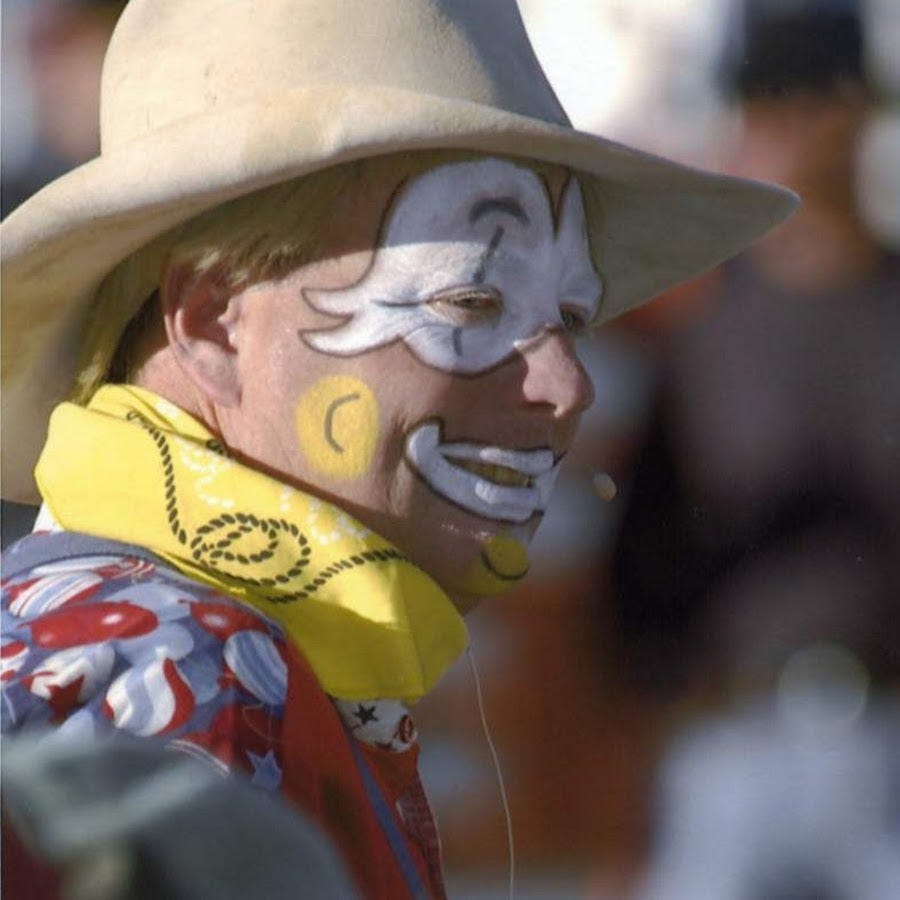
California rodeo clown Martin Kiff.
I hate that tired old phrase, “write what you know.” I’ve heard the opposite plenty of times—“write what you don’t know.” So which is it? Who knows anything? Until this story, I had never really addressed the part of myself that was connected to cowboys and rodeo. My grandfather is in the North Dakota Cowboy Hall of Fame, and toured America as a “pickup man.” My sister was twice Montana state champion in barrel racing. As a tiny kid, I was so excited to go to a rodeo, 40 MILES AWAY from our ranch. The flags, the music, the clowns, the element of danger. It was the biggest showbiz flash I had ever seen.
But at some point it stopped being interesting to me. Eventually I moved away to the West Coast and started writing for a living. It never once occurred to me to write about this world of cowboys and horses and bulls. Somewhere in the early 2000s, I don’t know what happened. I started thinking about that part of my background. Especially the rodeo clowns.
I drove up from San Francisco to Sonoma County, and met up with rodeo clown Martin Kiff. He doesn’t do much of the clown act anymore, but you can still hire him as a metal fabricator, or automatic gate installer. The photographer assigned to me was Terence Ford, and although he was and is a total pro, I cannot find any evidence of his photography online for this story. He was, however, the younger brother of actor Harrison Ford, and if that didn’t throw you off already, he sounded and looked just like him.
Thanks for reading. Subscribe for just $6 a month, if you want to support. If you choose to remain a cheap bastard and read this for free, honestly I don’t blame you. It’s Substack, and unless you’re fans of Heather Cox Richardson, or Sari Botton, or Robert Reich on a cloudy day, the platform appears to primarily operate as a complimentary buffet for “content” of varying quality—why pay at all! Who are these people? Who cares? Is that a steam table. of creamed corn? Whole dill pickles! Ooh, that insight resonates with my worldview! Click click click! But for those of us still writing and swinging for the fences, a paid subscription would really help pay our bills. And think of the release of tension for yourself. This was first published sometime in the early 2000s in American Way magazine.
Duncans Mills is a speck of a town, plopped into northern California’s Sonoma County, ten miles from the Pacific Ocean. Alongside the highway, the annual Russian River Rodeo is about to start its second day of action.
Barbecue smoke rises into the air, mixing with the earthy odors of dust, sweat, and livestock. Booths offer knives, hats, and other cowboy gear. Although only two hours north of San Francisco, we could be anywhere in rural America. Except for the bartenders serving glasses of Chardonnay.
Behind the rodeo arena, Martin Kiff sits in his trailer in front of a mirror, calmly dabbing white makeup around his eyes. He’s been a rodeo clown since 1981, carrying on a long-standing tradition that we all recognize, but few of us really understand.
I grew up in a rodeo family, and I have to admit, the most interesting aspect of any of it was always the clown. As a kid, I watched these country comedians entertain crowds with wacky and corny routines, usually involving little cars, toilet seats, suitcases filled with lingerie, brooms, burros, birds, monkeys, chickens, or in one case, a Chihuahua named “Pimiento.” Today Martin has graciously allowed my slight obsession, and agreed to explain the world of rodeo clowns.


Hall of Fame rodeo clowns Leon Coffee, Flint Rasmussen, Loyd Ketchum.
Over the years, Martin has worked rodeos around the U.S., including the Professional Bull Riders tour and the Dodge National Circuit Finals (whose winners qualify for the National Finals Rodeo in Las Vegas). He’s worked with some of the biggest clowns in the business, people like Leon Coffee, Flint Rasmussen, and Loyd Ketchum.
But he still loves to do the smaller rodeos, and today’s event is definitely small. There’s no ESPN camera crews, no big-name professional cowboys on the schedule at Duncans Mills. Just local guys and gals competing against each other.
“What you’re going to see today, this is what it used to be,” he says, pulling on a pair of garish yellow and black striped socks. “This is how it started.”
Another bonus of a smaller rodeo, is that the clown actually gets more time. “I’ll be doing two bits today. Usually I just do one. At the big rodeos, they want it done in two hours. It’s Hollywood, it’s fast, not that much fun.” He chuckles: “Give me the opportunity to goof off a little!”
The staple of any rodeo clown act is material the audience recognizes, he adds. “You try to keep it somehow ag-related. One of the funniest things about comedy—pain sells. I do a bit with a little fire truck, I have to rescue a cat out of a tree. Everything breaks, there’s a chance I could fall off the ladder. Your classic comedy. All those Jackass movies—if those guys weren’t getting hurt, you wouldn’t be watching it.”
He recalls a favorite routine, where he announced to the crowd, in great detail, that inside one of the chutes was a vicious fighting bull, and he was going to release it into the arena. The chute opened and out charged his trained Great Dane dog, outfitted with fake bullhorns.
“He came running out 90 miles an hour past all the chutes,” laughs Martin. “Cowboys were killing themselves to get out of the way, falling over the fence.”
Circuses like Ringling Brothers will hire the best clowns in the business, but Martin believes rodeo clowns are actually funnier. “We work in front of more people. You gotta play it by ear, you gotta deal with the elements. I’ve been in snow, I’ve been in 110 degrees, I’ve been in pouring rain.”
And when the bullriding event starts, the job gets serious, because a clown must also help protect a cowboy from getting stomped.
Bullriding is considered one of the most dangerous sports in the world. A rider attempts to hang on to a powerful 2,000-pound animal for eight seconds, and if he gets hit by the kicking hooves, the force can break bones, puncture a lung, or even kill a man. The pro rodeo circuit averages one or two deaths each year.
Fortunately for the riders, clowns study the psychology of the animal and learn how it moves, how it turns. A bull running at full speed is easiest to avoid, you simply step out of the way. But the smart ones, Martin says, will walk slowly toward the clown, because they know the human has to wait for the very last second to run away.
Sometimes being chased by a bull can be very entertaining. Martin recalls one rodeo in Salina, Kansas, when it was inevitable the bull was going to catch up to him. “I knew I was gonna get it, and I just started yelling as loud as I could: ‘AHHHHH!!’ He hit me right in the butt, and I went up and hit the top rail, flipped over and rolled, and landed in the seating area. I got up and kept going up the stairs, and there was this big fat lady coming down with a tub of popcorn. I stopped and thought to myself, clear as day, ‘You shouldn’t do this.’”
Martin couldn’t help himself. “I yelled twice as loud, turned around and ran back into the arena, and jumped over the bull who was still standing there at the fence! She was pissed. But the crowd went nuts, you know? I got in trouble, but it was just perfect.”
Rodeo clowns trace back to the early 1900s, when organizers would provide comic entertainment to keep people in their seats during a lull in the action. The early acts dressed like actual clowns, hillbillies, or inept policemen, and performed rope tricks and riding stunts. Many were performers from circuses or Wild West shows, or actual cowboys making extra money between events.
The clown’s additional duty of protecting the cowboy from an angry bull began in the 1920s, when rodeos started using Brahma bulls from Texas, a breed known for its distinctive humped back and nasty habit of attacking a man on the ground. Barrels were later added to clown routines, to both distract the bull, and protect the clown from harm. (One of the most famous clowns from this era, Slim Pickens, eventually starred in dozens of movies including the classic Dr. Strangelove.)
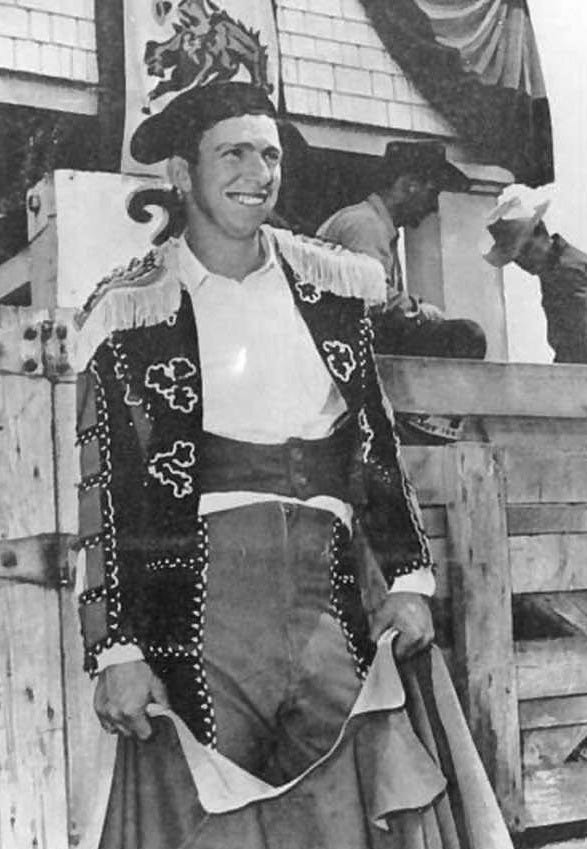
Slim Pickens as rodeo clown, circa 1948.
Until the early 1980s, there was only one type of rodeo clown. They did comic bits, joshed with the announcer, and protected riders from a wild horse or bull. At this time Wrangler began sponsoring bullfight competitions, and the events were so popular a subset of clown evolved called the bullfighter. These guys dressed like clowns, but usually without makeup. They didn’t tell jokes or brandish wacky props. Their sole task was to protect the cowboy, running around the bull and distracting it away from the rider.
The clown then became known as the barrelman, or “the man in the can.” Most rodeos now feature bullfighters as well as a barrelman. Dividing up the duties meant that clowns now have more time and freedom to develop their material.
Utah native Troy “Wild Child” Lerwill features trick motorcycle riding as part of his routines. Nebraska’s Butch Lehmkuhler incorporates a trampoline into his act. Dale “Gizmo” McCracken from Missouri has created the character of a crackpot inventor, and introduces a series of homemade contraptions. Montanan Flint Rasmussen, perhaps the most famous rodeo clown working today, uses his natural athletic skills to perform acrobatic comic bits based on rock music and popular movies.
“Flint has basically put us back on the map,” Martin says. “He has dance moves that a white guy shouldn’t have. He’s a funny, funny guy. It’s nice to have someone at the top represent you, that you really have a lot of respect for.”
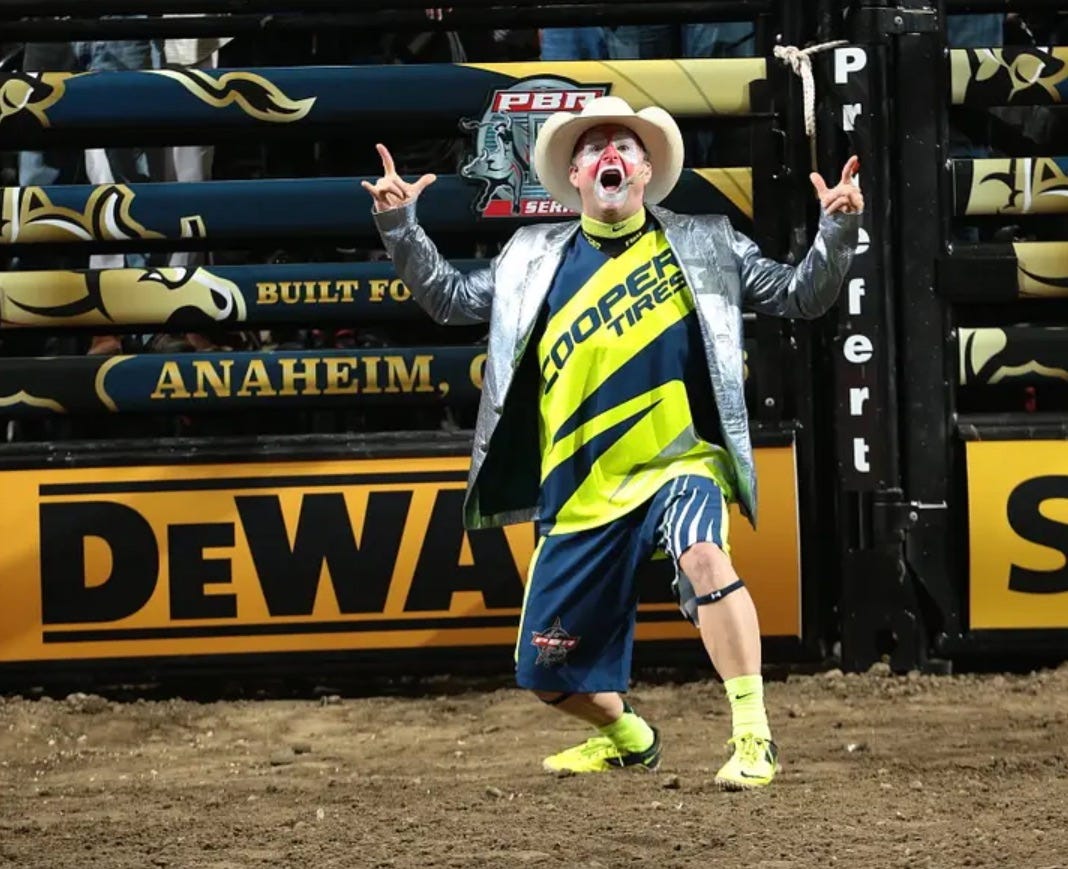
Flint Rasmussen wearing a David Lee Roth jacket, via Bull Stock Media.
Martin grew up in the nearby town of Healdsburg, and like most young adults in the 1970s, he loved the zany wit of that era’s comedians. He absorbed everyone from Richard Pryor to George Carlin, Woody Allen, Bill Irwin, and Monty Python.
While studying at California Polytechnic State University in San Luis Obispo, Martin got involved with the school’s rodeo team. He paid his dues, and when rodeo expanded to include bullfighting, he chose to remain a clown.
“Some people like the pain,” he says now. “I was always a wuss in that sense. I thought if I had a shot to keep going in the business and stay around, that was where it would be.”
When he started back in 1981, the clown business was in a slump. “A lot of guys were getting out of it. The image of a rodeo clown was the washed-up drunk. That’s the way the country songs described it.”
He quickly learned how to translate comedy you love personally, into an act that works in the arena. Many of the classic rodeo clown bits get handed down from generation to generation, and not always with permission.
“A lot of people would see a good clown act, then they’d throw that into their own routine,” he remembers. “Then the guy who started the act, it wasn’t his anymore. It’s hard to go to a town and say, ‘This is what I do,’ and someone will say, ‘Well, we already saw that.’ Texas is famous for that.”
Martin tells me one of his bits he’ll do today is a classic circus clown car routine, that he’s adapted for a rodeo crowd. He loads his lip with a pinch of chewing tobacco and I follow him out of the trailer.
The afternoon progresses through the bronc riding and roping events, and throughout, Martin wanders around the arena, carrying a hockey stick. When the announcer asks what he’s doing, he explains to the audience that he’s looking for pucks. “The green ones,” he adds helpfully.
After the team roping finishes, the action stops and Martin drives a tiny yellow truck into the middle of the arena. Bales of hay are lashed to the back of the vehicle. The announcer again asks what he’s up to, and Martin replies he has a truckful of rodeo clowns. The announcer acts skeptical and makes a bet, that he’ll give 20 dollars for every clown Martin can produce.
Martin says no problem, opens the door, and a stream of children pours out of the truck. The announcer counts each one out loud as they emerge, on up to an amazing 26 kids total, all laughing and fidgety. It’s hard to describe in words, but it’s really hilarious to watch.
“Okay, but I thought you said these were rodeo clowns,” says the announcer. “They have to be funny.”
Oh, they’re funny, Martin answers. He gathers all the kids and says he’s going to teach them all to walk like a bulldogger—a burly tough guy who jumps off a horse and wrestles a steer to the ground by the horns.
The kids all scrunch their butts down, hold out their arms as if rippling with muscles, make tough faces, and swagger about like a group of apes. The crowd roars with laughter.
Martin says they’re now all going to walk like a barrel racer—a female rodeo competitor whose cliché is that of a stuck-up beauty queen. As one, the children all point to the sun, then take their index fingers and push up their noses into the air, and strut about the arena. Again the crowd goes wild.
Being from a family of barrel racers myself, I feel slightly guilty for laughing along. But not much.
The routine ends, and the kids dash out of the arena, faces beaming with excitement. I catch up with Martin afterwards, and he tells me proudly, “Every one of those kids falls in love with rodeo.”
After 26 years, Martin says he no longer works the clown circuit full-time. He is busy raising a family, and running a custom metalwork business. But he still does several rodeos each year around the country, and is current president of the California Pro Rodeo Circuit.
“If you’re good and you show up and you’re nice to people,” he says, wiping the paint off his face, “it’s a hard job to screw up.”
Love the diversity in your journalism. And what a legacy!
Such a fun column. "If you're good, show up and are nice to people" - words to live by. Love the kids being roped in as part of the act and bold moment of improv running back to the bull to avoid the scary lady with popcorn.