The Tabloids Among Us
My ultra-brief stint as a reporter for People magazine

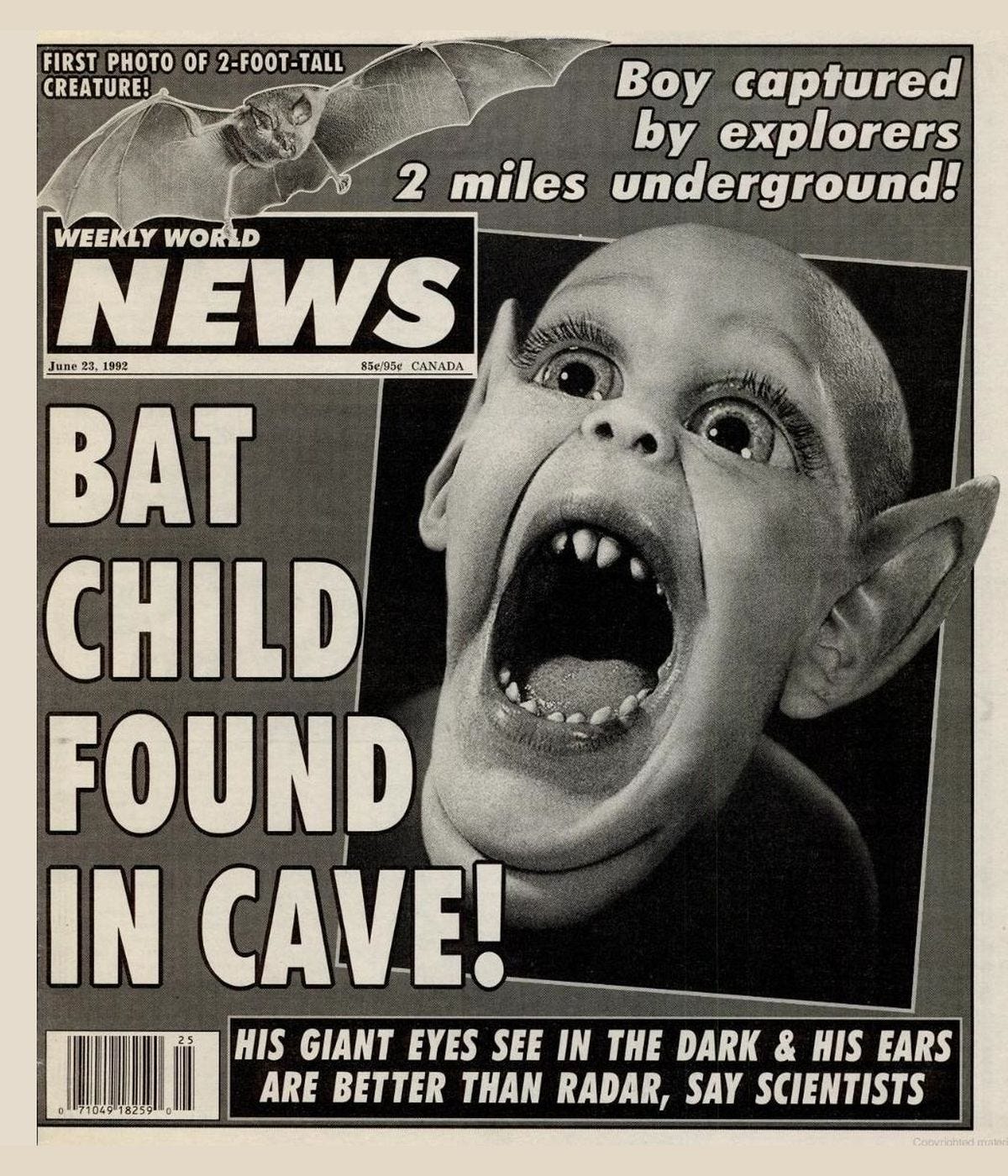
The Weekly World News classic “Bat Boy” story,
which later became an award-winning musical.
Before TMZ and a zillion camera phones, there were tabloids. In the 1990s, an era still largely dominated by print media, this culture was ubiquitous, a recognizable aesthetic flavor you saw appropriated and repurposed everywhere, from zines to ad campaigns, to artist Barbara Kruger and the Talking Heads.
This was also the zenith of the Weekly World News (a satirical offshoot of The National Inquirer), which gleefully pummeled America’s newsstands with preposterous stories: A “Bat Boy” discovered living in a cave in West Virginia. Photos of politicians like Bill Clinton and Ross Perot shaking hands with aliens. Bigfoot hookers, time travelers, Loch Ness monsters, a grey-haired Elvis discovered stepping out of a Burger King. It was common knowledge that while us insiders enjoyed the jokes, a significant portion of WWN’s readers believed it to be true.
So yes, some of that frisky tabloid culture was humorous and creative. But some of it was not. Especially if you worked for the biggest-circulation tabloid of them all. The following tale reveals a very short-lived period in the mid-90s, when I found myself freelancing for People magazine. Yes, that publication. Denzel Washington: “The Sexiest Man Alive!” Prom photos of Julia Roberts. Madonna’s wedding. Courtney Cox doing something or other. I’m not proud. We’ve all done crap things to pay the bills. So please enjoy my pain.
In the mid-90s I get a call from People magazine. An editor is visiting San Francisco, and wants to talk about doing some writing for them. We meet at his hotel bar downtown, it’s swank with picture windows. We order lunch and cocktails, and he spins out exciting People mag stories about touring with Frank Sinatra, traveling from city to city, and hanging out backstage with all the celebrities.
So I’m listening to this editor’s sales pitch, and thinking, I don’t know if I’m really that kind of writer. Also, isn’t Frank Sinatra dead by now? I remember that he fainted in the middle of performing “My Way” and smacked his head on a stage monitor.
But the $1000 fee per story? I am sufficiently intrigued, and so I agree.
Since I live in Northern California, my first assignment is local, about a court case in the East Bay. A schoolboy was harassing one of his female classmates, and the situation continued to escalate, and finally her parents took it to law enforcement. It’s an interesting, dynamic subject, the first case of its kind. The story appears in People and my name appears in print at the bottom (credited with additional reporting).
At People, and many other publications of this stature, everything goes through New York. A lowly freelancer interviews their sources, types up everything into a long memo and emails it in, and some other dude at a cubicle crafts the final version and gets the byline. In the old days they called it “gathering string.”
The check arrives, and now I’m in the door. Soon I will be touring on the road with Sinatra, or some other top-tier personality. Hopping on jets, staying in ritzy hotels. To my freelance credits, I happily add People magazine.
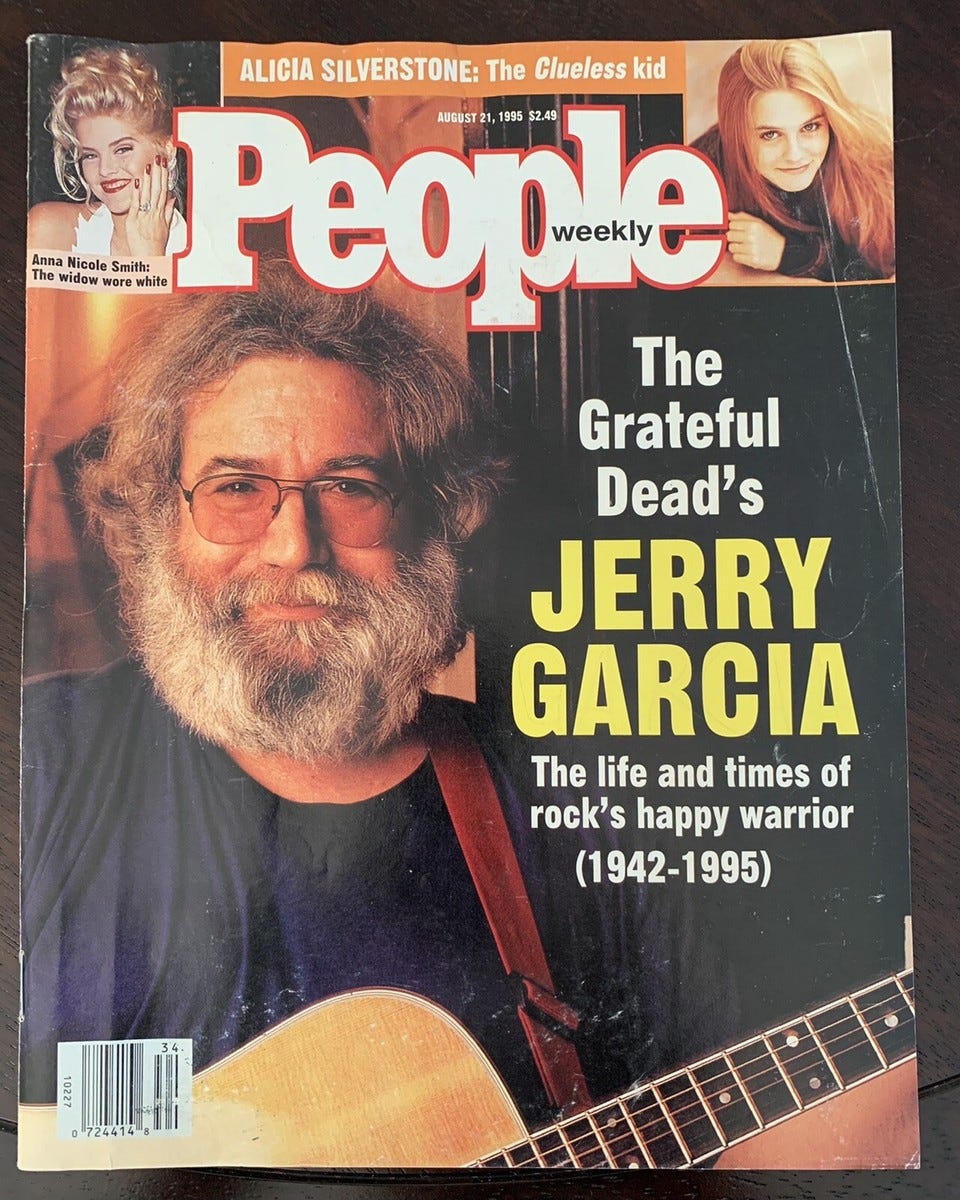
My next assignment is the death of Jerry Garcia. People is doing a big package about Jerry and his legacy. I attempt to get in touch with various family members, without any luck. Someone suggests I try Garcia’s friend, mandolinist David Grisman. I leave messages for him, but he’s not easy to find. In 1995, not much is yet online.
I tell this to the editors in New York, and they slip me a secret unlisted phone number. I’m told that if I ever get into a jam and can’t track down someone, call this guy. He’s a magician. He can find anybody. His name is Ron.
Deadline is approaching and I really don’t have a lot of options left, so I call Ron. An area code in Florida.
He answers the phone within one ring. I explain that I’m from People, and having trouble locating David Grisman. He asks me the basics. Social Security number? Don’t know. Last known address? Somewhere in Northern California. “Alright, let me call you back.”
Who is this guy Ron? Is he a hacker? Former military intelligence? Does he sit in a basement with a wall of screens, patiently chasing down random people for journalists? Or corporations? Governments? At this point, he seems more interesting to me than any of the Deadheads.
Fifteen minutes go by, and suddenly I get a phone call from David Grisman. He’s agreed to talk, and so we set a date and time. Seems like a cool guy. And of course an excellent musician. So it looks like I will indeed be part of the Garcia “package.”
Ron soon rings me back from Florida: “I got him.”
I explain to Ron, you know, actually now there’s no need. Grisman and I just got in touch, and it’s all cool, we’re going to chat.
Ron says, somewhat disappointedly, “Oh, okay. Well, I’ve got everything. Legal documents, contracts, I got all of his tax returns. Divorce paperwork. Wives, kids. I’m looking at his bank accounts.”
Jesus Christ. Is this even legal? Also, there’s enough info here for ten cover stories on poor David Grisman.
I can’t help it. I start to interview Ron. He’s very pleasant, but also very guarded and professional. So is he exclusive to People?
Oh no, he says. He’s freelance. All the publications use him, all around the US. I hear a woman’s voice from another room, and he says that’s my wife, we’re about to have dinner soon. I ask, does he work for the tabloids? Of course he does. Does he know Jim Hogshire?
Jim was a tabloid hack once upon a time, for the Enquirer and the other Florida rags, and eventually carved out his own niche as a drug writer, with a popular zine called Pills-A-Go-Go, and a book about the history of opium. Police had recently raided his house in Seattle and allegedly found a bunch of opium poppies, among other paraphernalia, and he left town and ended up in San Francisco.
I knew Jim a little, we’d published him in The Nose and reviewed his zine. So he crashed on my sofa for a few days. An unusual house guest. He was still a fiendish pill-head, and traveled with a fisherman’s tackle box filled with all sorts of tablets and capsules, nestled in little plastic trays. Since we both were in the publishing game, we walked the streets of SF, talking about books and writing, and the ridiculous tabloid culture. He had worked in that racket, and shared some fun stories.
I showed him a review copy of an O.J. Simpson biography, written by an old-timer crime reporter named George Carpozi, published before the murder trial had even begun. Carpozi was a character. He’d cranked out dozens of books on celebrities and crimes, making the sausage from news clippings, weather reports, and other publicly available sources. No shoe leather. A style known in the journalism world as a “clip job.” Some years he would bang out two or even three books.
We found his tough-cop prose style pretty hilarious. One favorite Carpozi phrase: O.J. Simpson was not accepted into a certain school “because his grades were stinko.” That’s old-school. Another passage detailed the California sun beating down upon the parking lot at Los Angeles County Superior Court, as pre-trial proceedings took place, and it was so hot, steam was issuing from the asphalt, and it was such a rambling, overly long paragraph of extraneous information, not connected to anything, it felt like old George was writing like he was getting paid by the word, and Hogshire pointed out, he’d probably never even visited L.A. in person.
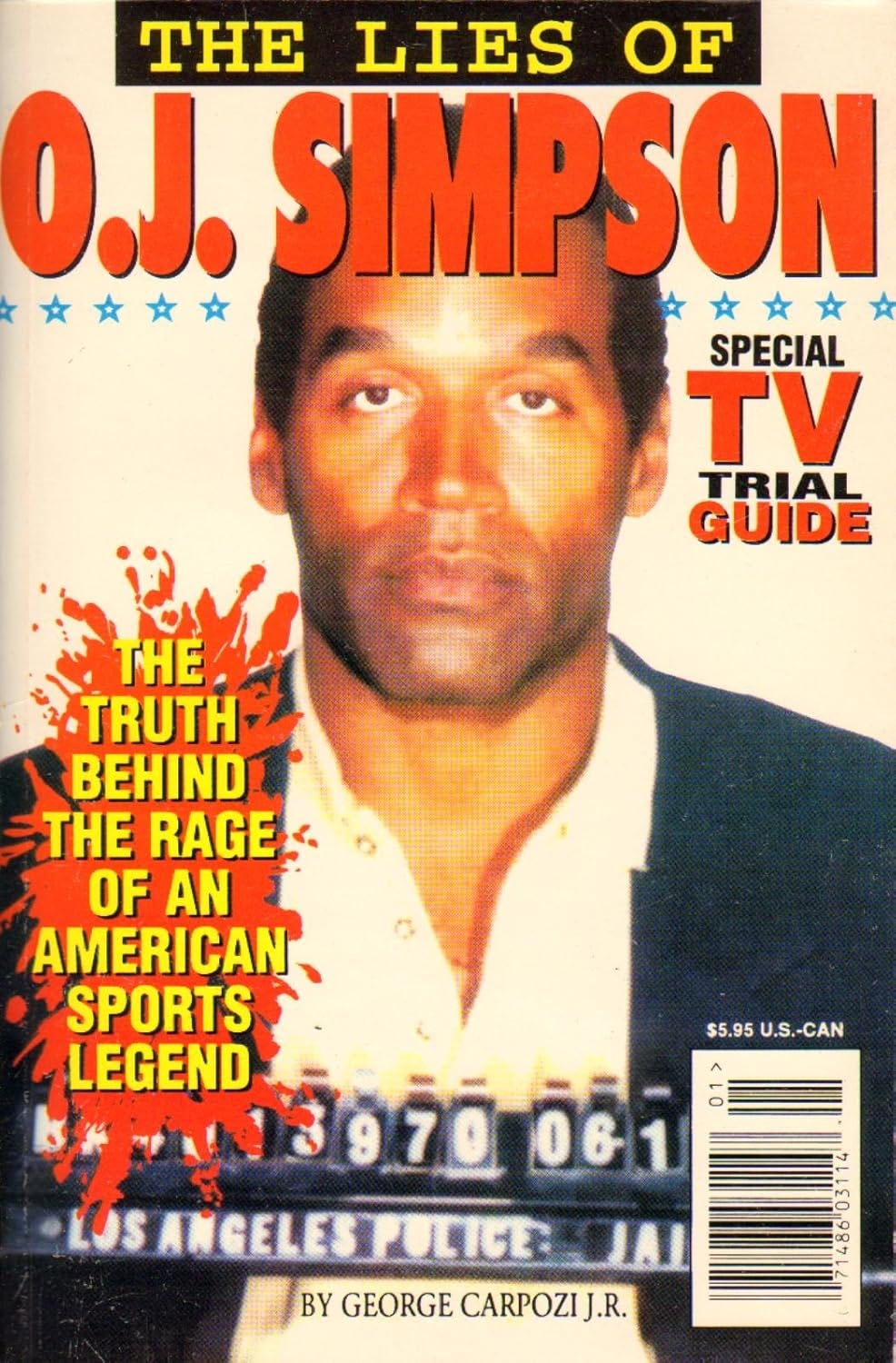
George Carpozi’s quickie book about O.J. Simpson, published January 1, 1995.
The Simpson trial did not reach a verdict until October 3, 1995.
When I ask Ron if he ever came across a tabloid writer named Jim Hogshire, he starts laughing. “Oh yes, Hogshire. With his little tackle box.”
I verify that indeed, Ron does work out of his basement. But before I can ask anything else, his wife calls again, and it’s time for dinner. I thank him for his help. “Well, just call if you ever need me again.”
I soon speak with David Grisman, about the death of his friend Jerry Garcia, and it’s pretty sad, as you can imagine. I transcribe my notes and send them to New York, to be assembled into the People memorial issue about Garcia’s “life and times.” My assignment is saved. Again, a thousand bucks into my very thirsty bank account.
People soon reaches out to me for a third story. It will be a disaster, and I will completely block out the subject. It’s the final story I do for that magazine.
This is the morning of Easter Sunday, 1996. My sources are located in the town of Monterey, and so I stop into a used car rental shop and pick up a crappy old compact, with dents and an AM radio, and head down the Peninsula.
I have been given an address by People staff, and cruise through the bucolic suburbs of sunny California, with carports and garages and well-manicured yards. I knock on a door. No answer. It’s Easter, people are out doing things.
I call New York, and they tell me, ok, not a problem, and give me a different address. So I drive around some more, and find the second house, and knock again. Nobody’s home. This is getting stupid.
Again I call New York. It’s not my usual editor, so I’m dealing with some poor bastard who’s also working on Easter Sunday, and his motivation levels appear to be quite low. He needs to call me back in a few minutes.
My phone rings again, and they read me a THIRD address. I drive around to a different neighborhood, and of course nobody answers that door either.
A neighbor in his driveway is washing his car. He asks what’s up. I tell him who I’m looking for. “Oh, they haven’t lived there for years.”
What a shitshow. In the time I’ve spent driving around Monterey, George Carpozi has probably written and published 17 more books.
People encourages its writers to expense things and save the receipts, so I drive down to Monterey’s Cannery Row, looking for a pricey restaurant where I can rack up a big tab. The Whaling Station Steakhouse bustles with an Easter crowd. Perfect. I sit at a table and order too many things, and chew by myself, the brain churning with weird thoughts. What a horrible waste of a day. Why am I doing this? Life is too short to be chasing down non-existent people, for a glossy fame-fucker gossip rag whose primary readers are in a doctor’s office waiting for the colonoscopy. There is no joy here. Writing for People magazine is turning me stinko.
I pull onto the darkened 101 North and head back to San Francisco. That’s it. I’m not going to do this anymore. I have no money, no job. Spiraling into the unknown. How many years can I keep living like this?
The AM station is playing “Radar Love” by the Dutch band Golden Earring. A 70s oldie, not my first choice for the scenario, but still a solid groove. The soundtrack of whatever tomorrow will bring. I roll down the windows and turn it up. Something else will happen.
Weekly World News officially folded its print version in 2007, and then relaunched online, with stories new and archival. A spin-off project, Bat Boy: The Musical, received many awards and has been staged in the US, UK, and Australia.
People magazine continues as one of America’s highest-circulation publications, with a readership of 46.6 million adults.
George Carpozi Jr. served in the U.S. Marines during World War II, and worked as a journalist for over 50 years before passing away in 2000. He cranked out more than 80 books, on subjects ranging from Clark Gable to Bobby Sherman, Jackie Kennedy, Gary Cooper, John Lennon, Carol Burnett, Cher, Kitty Kelley, Anwar Sadat, Bugsy Siegel, Bill Clinton, suicide cults, and you guessed it, Nazi gold.
O.J. Simpson famously was acquitted of murder in 1995, but lost a civil case filed by members of the victims’ families. He was then sentenced for armed robbery and kidnapping, and served time before being released in 2017. He died in 2024.
After a 60-year career, Golden Earring retired in 2021. Earlier this year the band’s surviving members organized a series of farewell concerts in Rotterdam.
Jack, this is “Stinko Gold”!
I love your mini-trip down People magazine’s glory years. One thing that stands out, not just for them but for all magazines in those days, is how much support you could get from the editor’s office — leads, “guys you can call”— not to mention the expenses. Boy, those were the days.
I could read multiple chapters about George Carpozi, king of the clip jobs. I did a clip job once, a book on Viagra I had to write in 24 hours, and the next week, I was at the San Jose airport and it was for sale! But you’re right, George was unmatched. Had six children! Busy guy!