The Nation's Smallest TV Station
Happened to be in my hometown

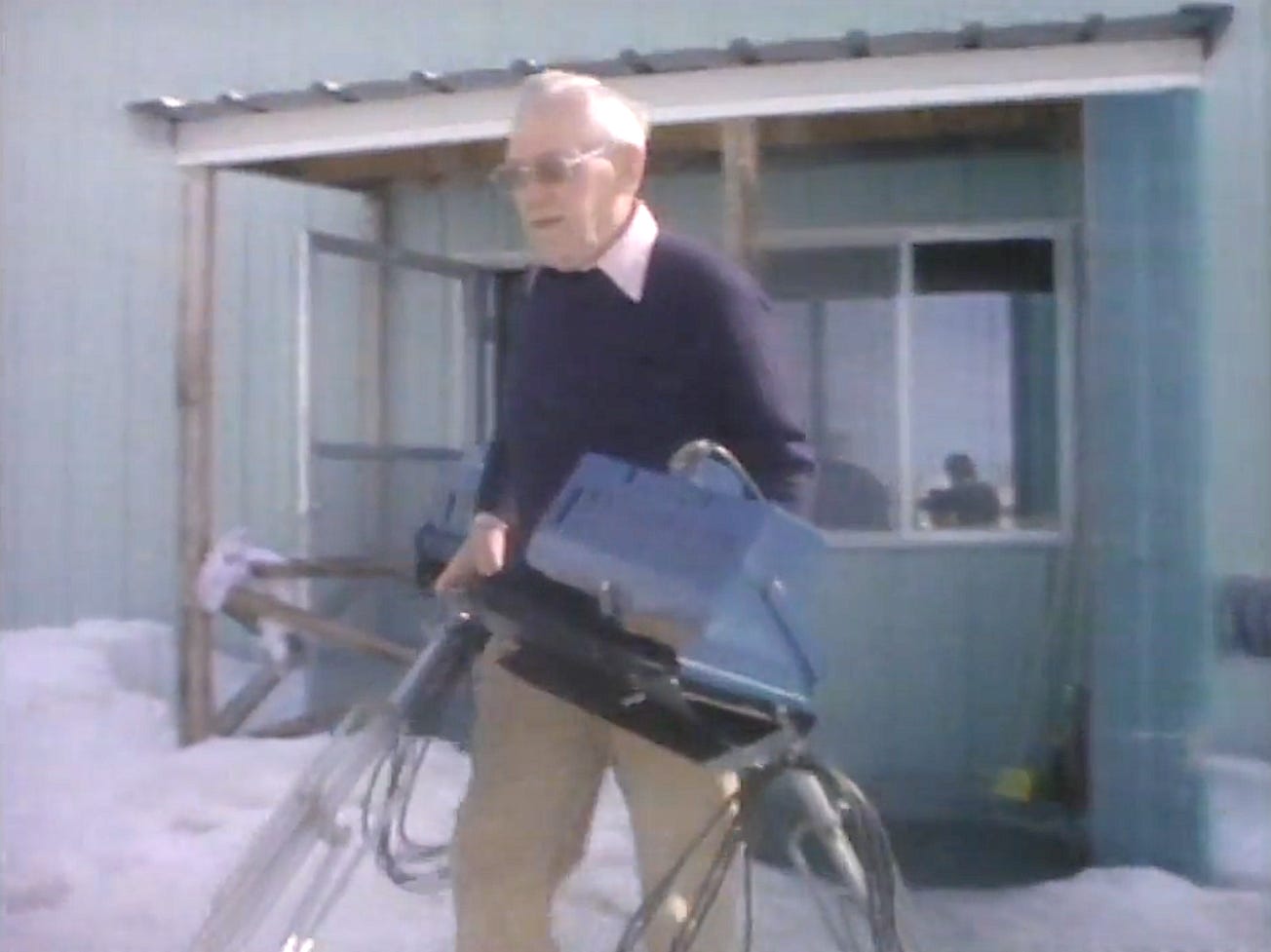
Owner Dave Rivenes huffing gear from America’s smallest TV station, 1979.
The preposterous UFC cage match that took place last weekend in front of the White House was a galactic, divisive waste of resources, from the overt promotion of a privately owned sport, to corporate sponsor logos, billionaire seat-fillers, and fighters paid off in Trump-crypto. It was tacky, and it was not good television. I can say that because I’ve seen the best television in the world. In fact, at one time my hometown in Montana boasted the smallest TV station in the United States.
KYUS-TV was a bona fide media curiosity in the ‘70s. Big-city reporters began to swarm—what exactly was this piddly little mom and pop station doing, where the owner would read the nightly news in a sweatshirt? As teenagers we all howled with laughter at the low-budget production and corny programs. But it really was an excellent primer for how to interact with television as an adult. You learned never to take TV too seriously. Behind the curtain, or off-camera, there’s always Scotch tape holding it all together. And if station owners David and Ella Rivenes seemed to be a little eccentric, well so what? It’s their equipment.
Here’s a remembrance of KYUS, based on my own experiences, At the bottom, you can view a fantastic segment about the station, from the NBC show Real People, hosted by Fred Willard. Portions of this have been posted to Facebook, and performed at the Edinburgh Castle in San Francisco.
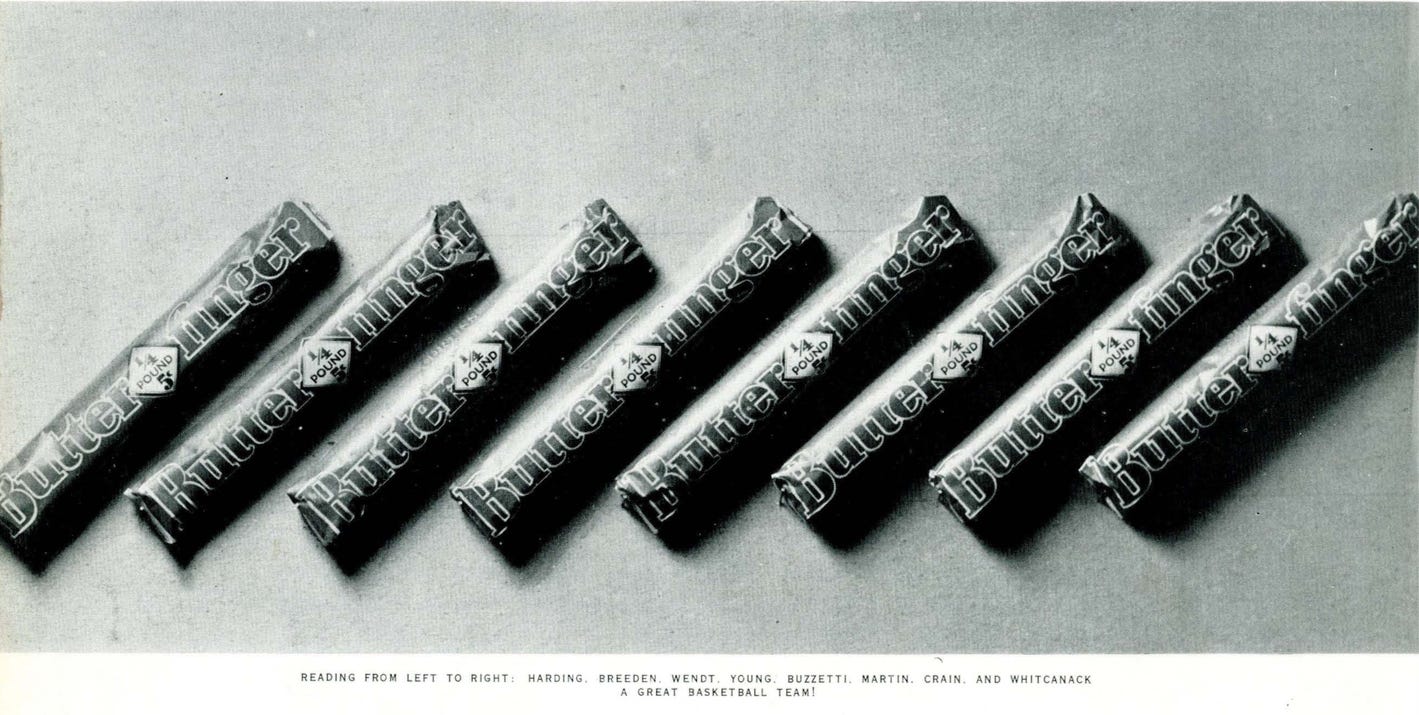
Photo of the basketball team, The Montanan yearbook, 1933.
It’s the late 70s and I’m a freshman at Montana State University. It’s primarily an agricultural school, with some engineering, and an early computer curriculum. The film studies department is tucked away in an old brick building, and there are very few of us. Most of the students are from out of state. Apparently this department also will produce director John Dahl and actor Bill Pullman, but I never saw them. We just learn about film in an arty-farty cone of isolation.
One day as I enter the building for class, I notice a display of items in the lobby. Positioned under glass are displays of The Montanan yearbook from 1933. Why should anyone care? It’s been 45 years. Why are we supposed to see this now? I stop to check it out, and soon realize, oh, this is kind of amazing. This is actually a parody of a college yearbook. The humor is not as sick as my ‘70s zeitgeist, SNL and National Lampoon, but it’s pretty amusing, and the ideas are original.
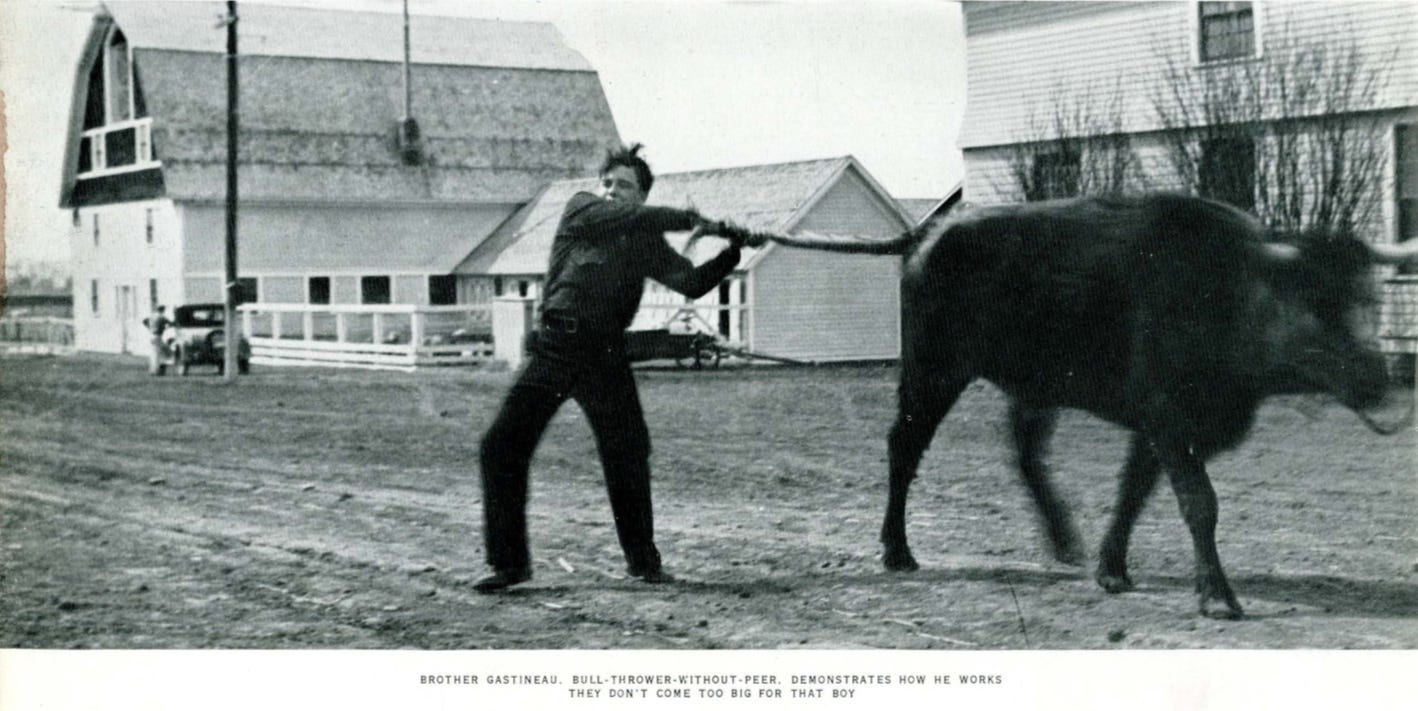
Brother Gastineau, champion bull-thrower.
I keep reading, and it dawns on me that this is in fact the actual yearbook for 1933. A placard indicated that the staff had produced two different versions. One normal edition went to the faculty for approval, and the other, stuffed with jokes and strange photos, went directly to the printer.
The humor ranges from silly—the basketball team represented by a photo of Butterfingers candy bars—to actually kind of ruthless. Immediately following a segment of students in the Hall of Fame, photos appear of students who are nominated “for oblivion”—“Allan Schwartz…because he is continually blowing off at the mouth over things he knows absolutely nothing about, and because his sole reason for doing so is for the publicity.”
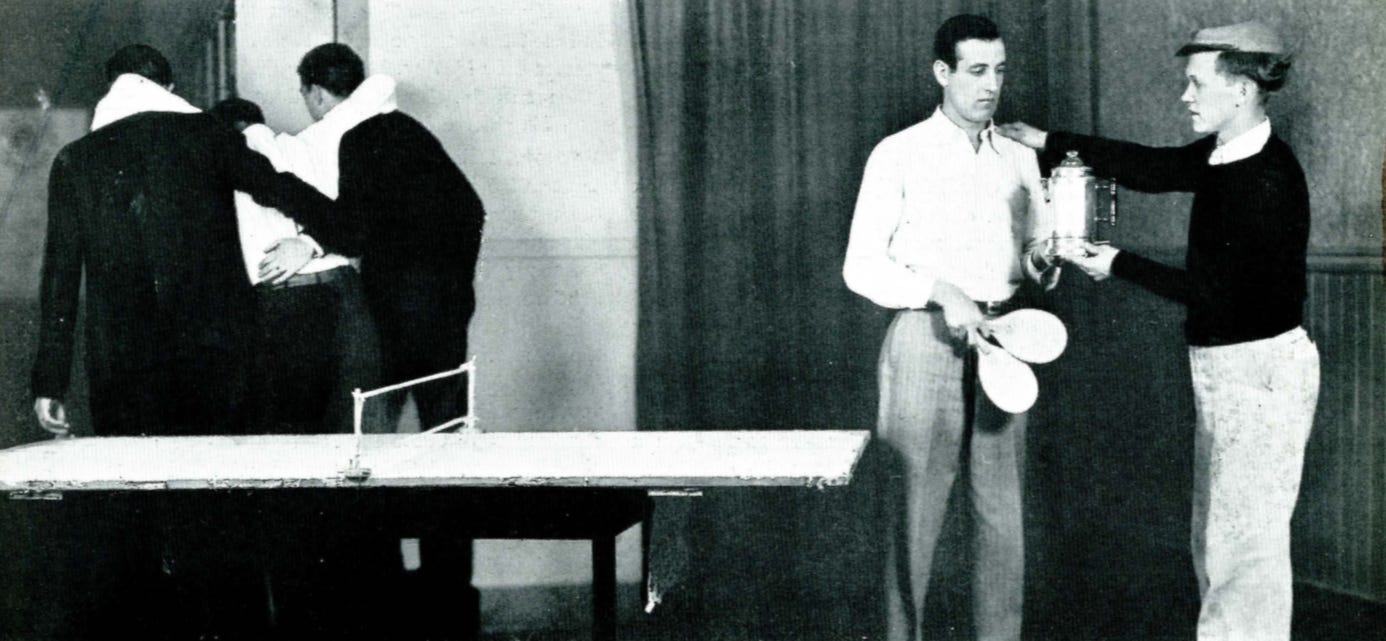
Ed Breeden defeats Jimmy Young in ping-pong.
Campus sports depict a “bull-thrower-without peer,” an image of track athletes tangled up in hurdles, and a ping-pong championship match where the loser is essentially carried away by assistants: “The trophy for ping-pong went to Ed Breeden, when he defeated Jimmy Young after a long struggle.”
Every sorority is described in identical language: “All the popular girls on campus are members of this sorority.” Instead of text that describes college life of Montana State students, the words are lifted and reproduced verbatim from The Rover Boys at College, part of a popular Hardy Boys-type series written for children. Throughout The Montanan appears a mysterious, goofy hobo-tramp character named Clarence Mjork, who seems to be involved in all facets of the school. He hangs from a lamp, and poses with a fish. He is listed as adviser to every single student. He is the yearbook editor-in-chief as well as its proofreader, printer’s devil, and military editor, and belongs to more than 25 clubs.
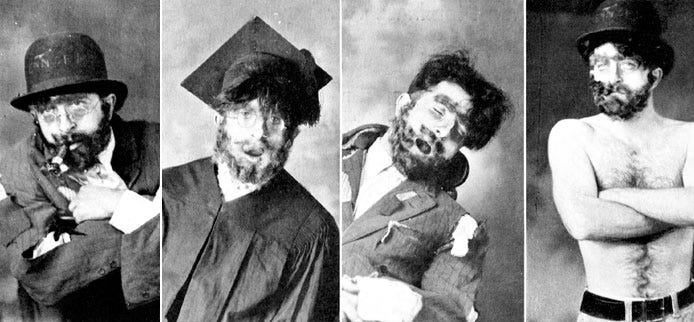
The many faces of Clarence Mjork.
In a golden touch, the yearbook is prefaced by a hearty and sincere, if completely oblivious welcome from college president Alfred Atkinson:
“During periods of business depression, it is important that insofar as possible, there should be continuing records of attainment and general group activities that have proven valuable under normal conditions. It is gratifying, therefore, that the present Montanan staff has maintained the customary high standards in this year’s Annual. It reflects the confidence of the oncoming generation in the soundness of America’s opportunities.”
Once Atkinson discovered the ruse, it was too late to recall the yearbook from the printer, aside from a few photo substitutions. So the 1933 edition of The Montanan would go down in history, and be distributed to students, as that year’s official yearbook.
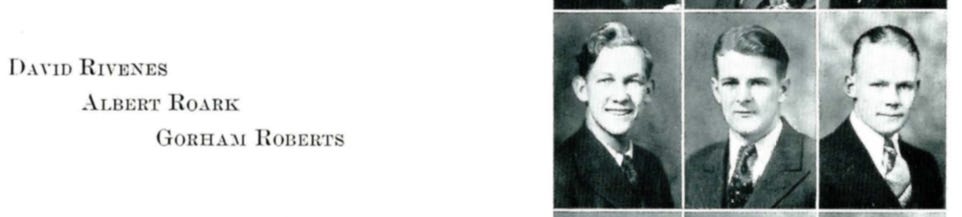
I absorb all of this, and one final display lists the actual editor/chief perpetrator of this massive hoax. His name is David Rivenes. And as a result of this project, he was ejected from his fraternity. Wait a minute, I think. I know this guy. He lives in my hometown. And he runs the smallest TV station in the United States.
Now we go back to 1970 or 1971. My fourth-grade teacher announces one day that the class will be participating in a spelling bee on television. When Mrs. Johnson speaks it’s usually confusing, because she is cross-eyed, and when she asks one child a question, three kids will answer. But this time she’s speaking to all of us, saying that we are going to be on local TV. And we know exactly what she means.
The KYUS station in Miles City, Montana, has been broadcasting for a few years. The call letters KYUS come from the word “cayuse,” which is defined as a small range pony. To the rural areas of southeastern Montana, it’s the only channel available, a black-and-white portal to the outside world. The station identification image is a slide of a horse, standing on a snowy hill in a blizzard, over which a pre-pubescent boy’s voice announces proudly, “You’re viewing KYUS-TV, Channel 3, Miles City.” (Some years later I will actually meet this kid in junior high. His name is Merlin Brown, and he lived near the station and was coaxed into doing the voiceover for free.)
We know that a balding guy named Dave Rivenes started and owns the station, along with his wife Ella. They’re friendly folks, both wear glasses, live in a big brick house on Main Street, and drive around in an old ‘50s Thunderbird convertible. Ella rotates an assortment of loud-patterned housewife dresses. Dave favors a pair of cords or khakis, hitched up high over the stomach.
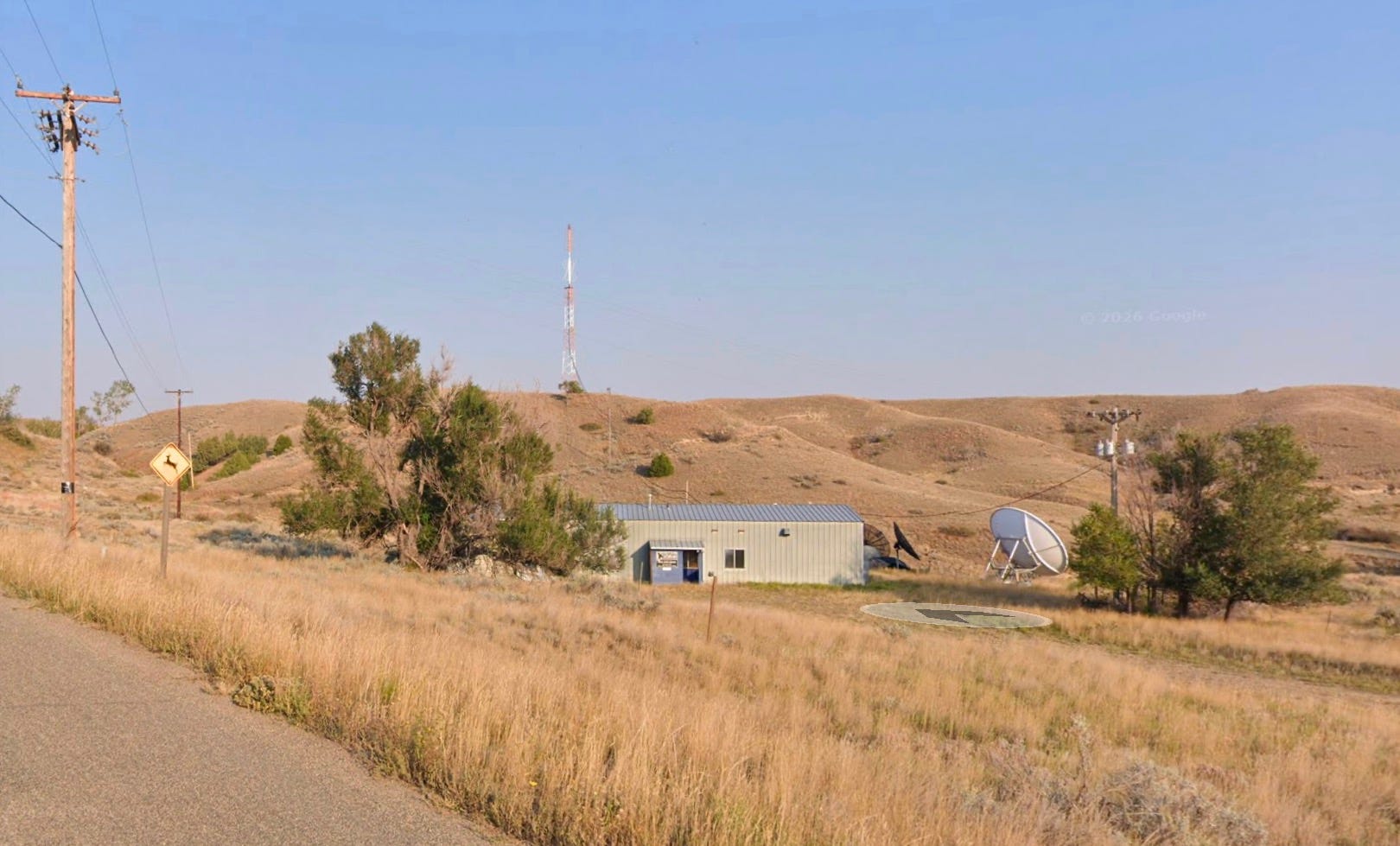
The former building of KYUS-TV, via Google View, 2026.
A school bus soon shuttles our class across the Yellowstone River to the KYUS studio, a metal-sided building on a gravel road, tucked between treeless hills. From the exterior it looks like a transmission shop. We file into the building, through the darkened studio, past the cameras to a brightly lit riser and a phony brick wall. There he is—in person, Dave Rivenes! He wears a flannel shirt, khakis and tennis shoes.
We are all excited and noisy. This is big-time television! Most of us have already seen the spelling bee show. Each week the station invites a different group of children from around the area. One night it might be kids from Rosebud County, another from the town of Terry, or the entire student body of Kircher country school. Tonight it’s our turn, Mrs. Johnson’s class from Lincoln Elementary.
We line up against the fake bricks, giggling and fidgeting, awaiting our shot at glory. Directly in front of me is Kelly Hedge. Kelly is already an amazing natural athlete, one of those gifted kids who can pick up any sport and immediately excel at it. He is also dumb as a post. The red light turns on, and Dave Rivenes welcomes viewers. We are on the air.
I stand in line, waiting impatiently, watching my classmates struggle over their words, and inside I’m thinking, “Oh come on, I know that word—that’s so easy! Let’s go!” Now it’s Kelly’s turn. I watch him take the stage, remembering that it was Kelly who had stolen my bicycle in second grade and repainted it with a broom. When my mom asked him about it, he denied all knowledge. Okay, Kelly, let’s see what you can do.
Dave leans down, holds out the microphone, and says, “Alright, Kelly, your word is…‘kitchen.’” Kelly looks around, laughs uneasily, replies, “K…” and freezes, unable to add another letter. Stupid jock, I think to myself. Bike thief. Dave gives him another chance, and Kelly tries again, “K….” He stands there, chuckling nervously, as if someone will recognize his boyish charm and give him a passing grade, a technique he’s already mastered even in fourth grade.
Dave isn’t buying it, and whisks him offstage with a soothing, “No, I’m sorry,” in a calming tone that says life is inevitable and ever-changing. Dave has done plenty of spelling bees. He has lowered the boom on dozens of little kids, and knows just how to deliver the news. He can easily have been a mortician.
At last it’s my turn. Dave asks my name, and then says, “Your word is…‘success.’” I immediately answer, “s-u-c-e-s-s.” He pauses, and I think, Dave, what’s your problem? “Now that’s not quite right, Jack, I’m going to give you more more chance. One more chance to spell the word…‘success.’” Somewhat irritated, I shoot back, “S-u-c-e-s-s.” Spell it the same way. “No, I’m sorry,” said Dave.
I slink off the set, destroyed. I was so cocky, and when it comes down to the wire, I choke in front of everyone. It’s folklore that any kid who appears on the spelling bee always remembers the word they spelled. But what a word to flub. A few years later I will win the county spelling bee. But the KYUS moment haunts me for years. Is it a subconscious curse upon my head? Every time I have a setback, I think, “Is this because I couldn’t spell it on KYUS?”
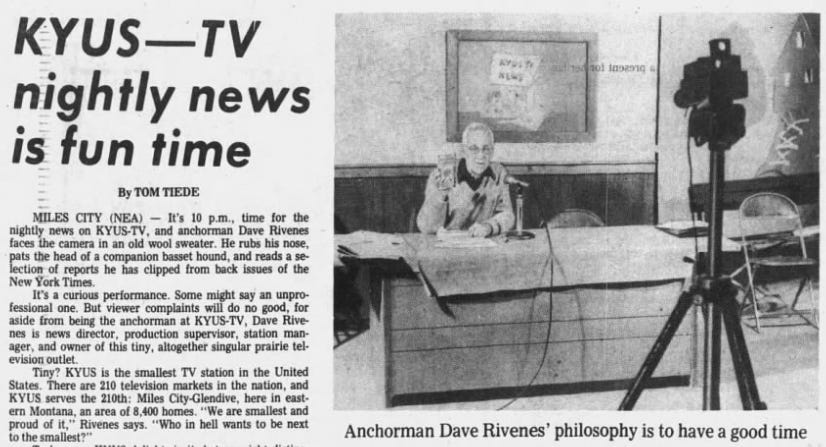
News story, most likely Billings Gazette, 1988.
Now it’s the mid-70s, high school English class. A bunch of us are sitting in the back of the room, waiting for the bell. The subject of KYUS comes up, and everybody suddenly comes alive. Jocks, stoners, cowboys and cowgirls, band geeks, math nerds. All of us have grown up with this phenomenon we call “The Dave and Ella Show.” It’s been a common thread throughout our lives. We’ve all flipped through channels, and suddenly something will catch your eye, like a slowly rotating half-eaten package of doughnuts, or a politician coerced into delivering the weather forecast. We all know it! It’s a liberating feeling to know this is our local television. Everyone watches to see how bad it can be. It becomes entertaining on a cosmic level. You’re torn between feeling sorry for the station—your town, yourself—and just falling over with laughter.
We start swapping stories. The children’s program “A Visit with Henry,” in which Ella is the host, sitting in front of a large piece of cardboard shaped like a shoe, with little cut-out windows. Each week she chats with a character named Henry and his friends, who appear at the windows, and speak in falsetto voices, all of which sound essentially the same. One person recalls the moment when the giant shoe suddenly falls down, exposing Dave on his knees, with puppets on his hands, and he crawls off camera.
Dave fills in for Ella one night on the cooking segment, and shows viewers how to create a salad by sticking a banana through a pineapple ring…If it starts to rain, Dave will leave the set, the camera still broadcasting an empty chair, go outside to roll up the windows on his car, and return wiping his glasses.
The nightly newscast is guaranteed to please, as the host will obviously read headlines directly from the day’s newspaper. I contribute the memory of once observing Ella stop to smack a fly with a flyswatter, then casually scoot the dead insect off the desk, and continue with the news. On one broadcast, Dave pauses and says, “I’d like to call your attention to a couple of items here, of importance. Found a checkbook today out on the parking lot at the…(holds up checkbook) where was it, Gary?” Yet another night, as Dave is reading cattle prices, a dog keeps barking off-camera. Finally he loses his cool, turns and shouts, “Could someone please shut up that dog?”
The KYUS fun is also interactive. Kids will often call the station to hear the phone ring live on the air. Dave might be in the middle of a newscast, and suddenly in the background, you hear, “Riiinnnggg.” He ignores it and continues. “Riiinnnggg.” After ten or fifteen rings, Dave’s patience turns into a stoic-yet-simmering fury. He sets aside his papers, points at the camera and announces, “You kids out there who think this is funny, you’re just interrupting the news, that might be very important to someone else. The joke is over. You’ve had your laughs. I suggest you stop it right now.” He pauses, giving a glare of disapproval. A few seconds later: “Riinnnnngggggg.”
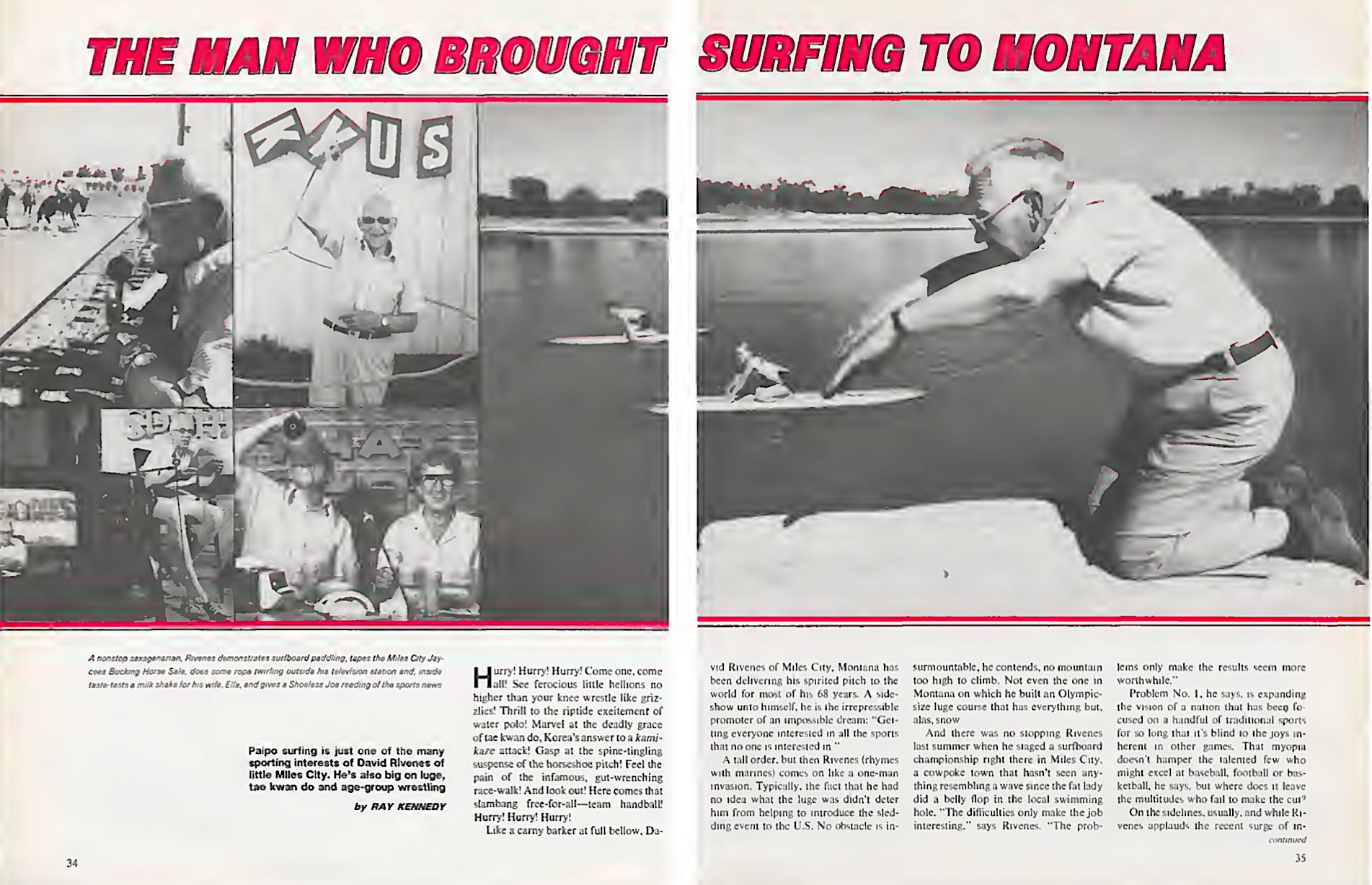
Dave Rivenes in the pages of Sports Illustrated, 1980.
America’s media begins to discover KYUS, and it becomes the subject of stories in TV Guide, Wall Street Journal and Newsweek, TV segments by John Chancellor and David Brinkley. A detailed feature in Sports Illustrated in 1980 sifts through the lives of Dave and Ella, and we learn that Dave has enjoyed a long career promoting sports. In 1966 President Lyndon Johnson honors him as Fitness Leader of the Year. In the 1970s he serves as national president of the AAU (Amateur Athletic Union). He lobbies to have the luge included as an official Olympic event. But what really catches the attention of reporters are the odd sports. Tae kwon do, freshwater surfing, a Russian martial art known as sambo, and something called jammu, a racquet game played with a nerf ball. Perhaps the nadir of Rivenes’ eccentricity is his effort to get rock skipping accepted as an international sport. Journalists eat it up.
“If you can promote one sport, hell, you can promote them all,” he tells Sports Illustrated. “The administration is all the same. You don’t have to know how to spell it or pronounce it to promote it.”
Ironically, Dave Rivenes appears to be the opposite of athletic—slight and balding, looking more like a banker ready to disapprove a loan. But all these years later, somehow it begins to make sense. The same college kid who sabotaged his own yearbook should end up promoting the luge and rock skipping, convincing viewers to stick a banana through a pineapple ring? Why not?
Dave (and Ella) Rivines led by example. They made their own path, and tried to have fun along the way. They got to travel to other countries. I mean, they weren’t my parents, but you can still observe and learn from them. They give you permission. And in the case especially of Dave, his creativity, rebelliousness, self-aware silliness, and the balls to just broadcast it out there, or bypass the faculty and ship it to the printer. You have to respect that. I hope in some ways I’ve unconsciously absorbed the Zen of Rivenes, the Tao of Dave. And in reading this, perhaps you will also.
My favorite media hit of KYUS comes a year earlier, in 1979, during the first season of NBC’s Real People. The program features a comedian/actor named Fred Willard, who has already been a regular on Fernwood 2 Night with Martin Mull, and will eventually star in Christopher Guest films. Willard lands this roving correspondent gig with Real People, and they send him to my hometown to cover the nation’s smallest and lowest-rated TV station. It truly sums it up. Here’s the entire segment:
KYUS-TV is still on the air, now a PBS affiliate owned and operated by Montana State University.
David Rivenes died in 2003, at the age of 90. His wife Ella passed away in 2011, aged 95.
That is freakin’ fascinating—what a legend, just for the yearbook prank alone! In the midst of the Depression, a total satirical middle finger to higher education and the American dream! Little rebel.
High-freakin-larious! You certainly did absorb the Zen of Dave.