But Wait, There's More!
The heyday of TV pitchmen

America claims a long tradition of shameless hucksterism, from the horse-drawn wagon of miracle elixirs, on up to TV infomercials and eventually, a president of the United States who says things like “big and beautiful,” as if he’s selling us a miracle kitchen mop.
Our influence may have faded around the world, but there’s one thing we still do better than any other nation. We sell shit to each other. It’s the eternal game we instantly recognize. No matter how unnecessary the product, we are forever dazzled by the discounted price, the promise of innovation, the 2-for-1 deal. The goofier and cheaper the pitch, the better. And the message should be repeated so often that it burns into our brains, and people quote it to each other and laugh.
You could say there is a common thread of twisted brilliance in our collective DNA, in that we eagerly train our own citizens to hear information and not question how erroneous it might be. If we’re sufficiently entertained, the pitchman is a genius! Give him an award!
But as anyone in business knows, sales and marketing is often not enough. Sometimes you achieve success in a way that makes you feel invincible to the law. You bend the rules. And often it doesn’t end well.
Here’s a short and certainly incomplete compendium of classic pitchmen. Some of this history is difficult to research and sources can be fairly sketchy, so let me know any corrections. And please add your own memories in the comments!
NATIONAL STARS
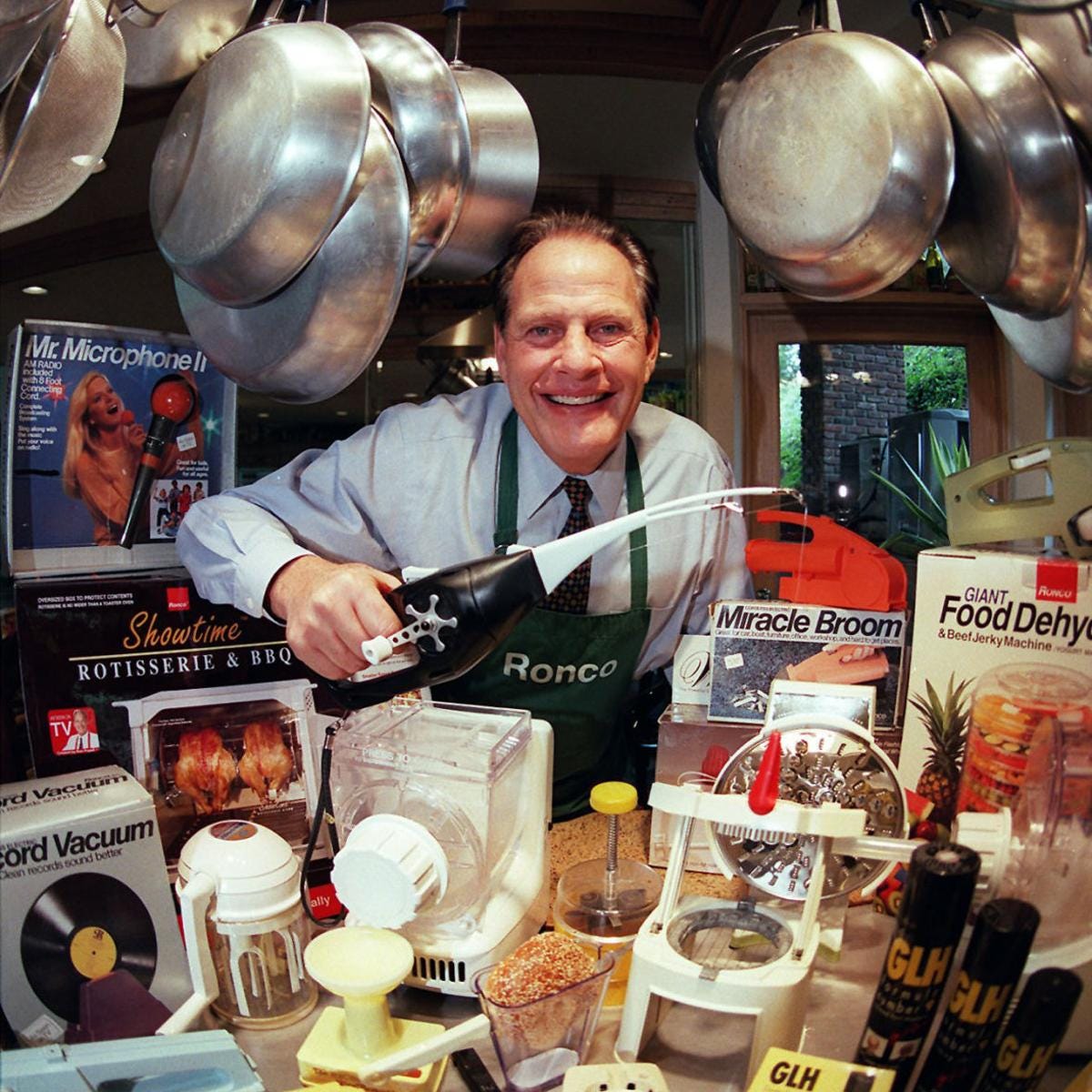
But wait, there’s more: Ron Popeil and a portion of the junk he sold to America.
Ron Popeil inherited a flair for gizmos from his father Samuel Popeil, who invented the Veg-O-Matic, and then left Dad’s firm to form the Ronco company, blitzing the airwaves of 1960s-70s America with dozens of products, most memorably the Pocket Fisherman. He starred in his own ads, and popularized many catchphrases such as, “Set it, and forget it!” Ronco was sold to a holding company in 2005, and Ron Popeil passed away in 2021 at age 86. He never had any notable run-ins with the law or arrests of his own. However, his socialite stepmother Eloise Popeil was convicted in 1974 of hiring hitmen to murder his father, to make room for the sidepiece boyfriend. She served 19 months in prison before, oddly, the couple reconciled and remarried.
Jerry Carroll in a 1978 commercial for Crazy Eddie.
Eddie Antar ran the Crazy Eddie chain of electronics stores in the NY area throughout the 1970s and 1980s. His low-budget spots featured the voice of local DJ Jerry Carroll, who made famous the tagline, “Prices are in-SAAAANNNE.” The operation would eventually grow to include 43 stores. Members of the band Queen once made an in-store appearance, and the ads were famously parodied by Dan Aykroyd on SNL. Fraud began in the usual manner—underreporting income, skimming sales tax receipts, paying employees off the books—and millions of dollars were deposited in offshore accounts. The company attempted to trade publicly without success, and it declared bankruptcy in 1989. Antar was convicted on charges of fraud and insider trading, and was sentenced to eight years in prison. He died in New Jersey in 2016, at age 68.
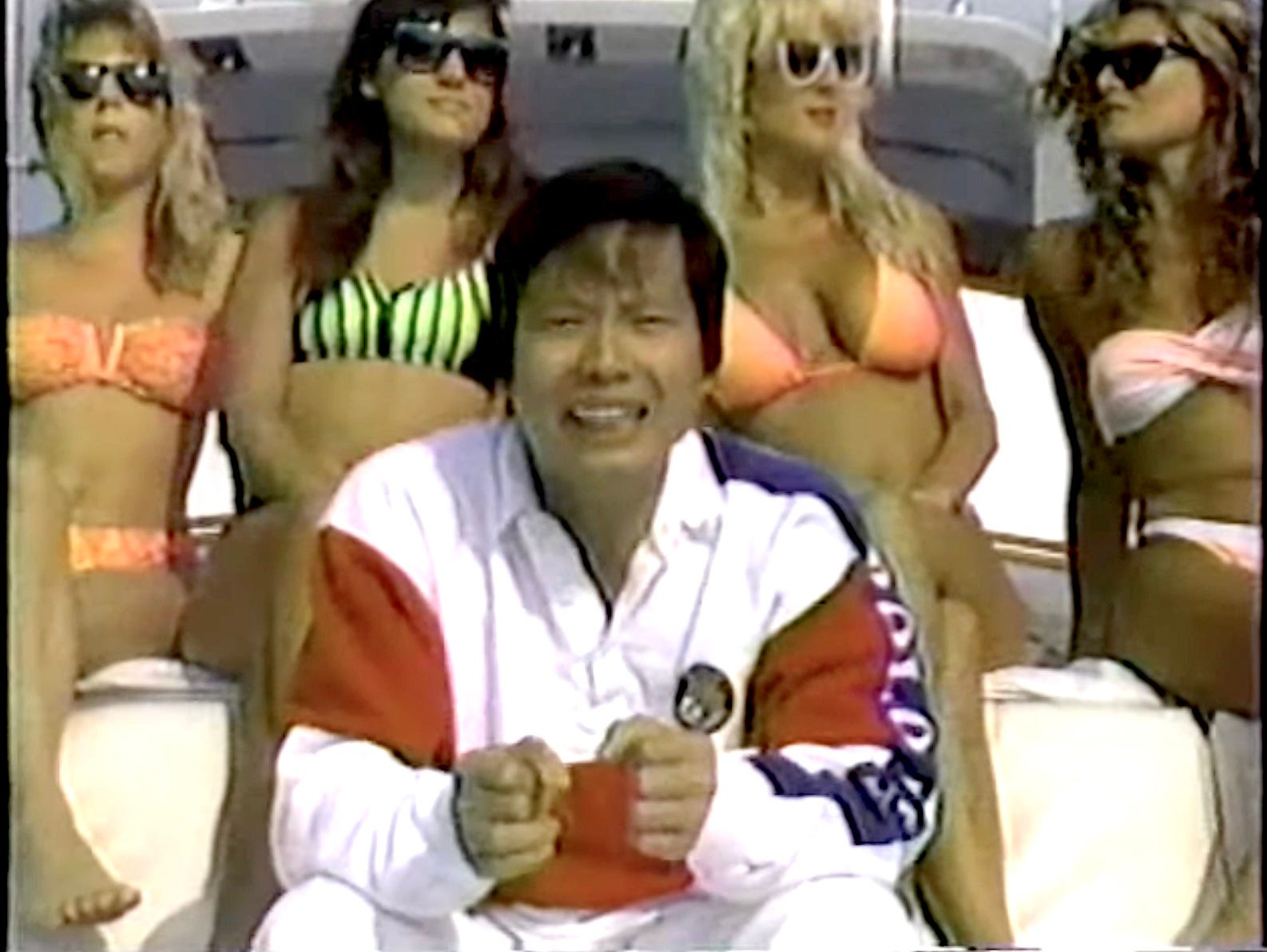
Tom Vu commercial: “You deserve to be broke.”
Tom Vu was born into a wealthy family in South Vietnam and moved to the U.S. as a teenager. His commercials ran throughout the 1980s, pitching surefire real estate seminars that urged customers to be smart and not be a loser: “Today I’m going to show you how to drive a sports car. First, you need a lot of money!” His visual aesthetic was immediately recognizable—sitting on the deck of a yacht, surrounded by disinterested babes in bikinis. In the early 1990s, Vu was sued by former students and investigated by government officials for alleged violations of securities laws, fraud, and false advertising, but was never formally charged with any crime. Today he makes his living as a professional poker player.

Billy Mays for Mighty Putty.
Billy Mays was the amped-up star of dozens of Home Shopping Network commercials in the early 2000s, pitching everything from kitchen gadgets to Mighty Putty and OxiClean. Among his catchphrases was the zesty “The best things in life are free—and $19.95.” He co-starred with fellow hustler Anthony Sullivan in the Discovery documentary series PitchMen. In 2009 he was found dead in his home in Florida at age 50. Toxicology reports revealed his body contained traces of cocaine, hydrocodone, oxycodone, and tramadol, as well as anti-anxiety drugs alprazolam and diazepam.
BAY AREA ALL-STARS
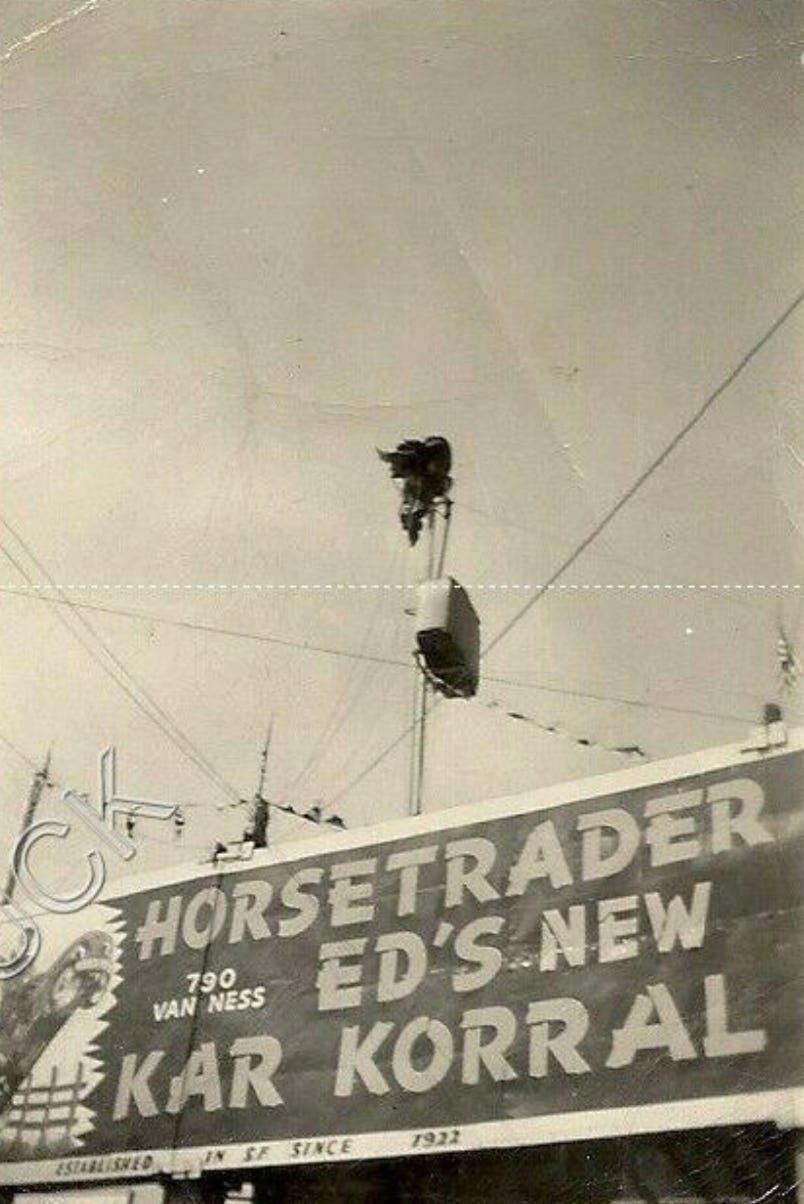
A pole-sitter at Horsetrader Ed’s Kar Korral in San Francisco, 1940s.
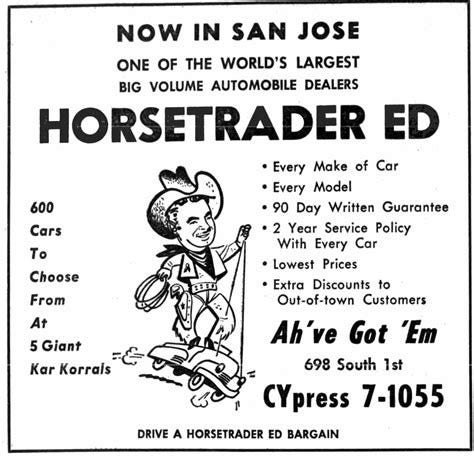
“Horsetrader” Ed Shapiro began adult life as a car thief, and spent two and a half years in San Quentin before reinventing himself as a San Francisco used-car salesman with a flamboyant Western theme. He circulated with mayors and movie stars, and staged offbeat publicity stunts like employing flagpole sitters at his car lots, all of which were named the “Kar Korral.” With the invention of television, he did his own spots wearing a cowboy outfit and six-shooters, riding a horse on camera and shouting, “You want ‘em, Ah’ve got ‘em!” In 1953 he was convicted for tax evasion, sent back to prison, and lost his home and business.
In a bizarre twist, a former NFL football player named Ed Balatti then took over the “Kar Korral” operation, and also assumed the name of “Horsetrader Ed.” Balatti could sell cars, but his humor and gift of gab were, it was said, most often utilized in wooing society women of Pacific Heights. In 1986, after an 11-month investigation, he was arrested and charged with fencing stolen goods, including items missing from stores like Shreve’s, Gump’s, Macy’s and Neiman Marcus. When police searched Balatti’s ornately decorated Russian Hill condo, they discovered it crammed from floor to ceiling with expensive clothes, crystal and other luxuries. He was sentenced to six years in San Quentin.
Shapiro retired to San Jose and passed away from cancer in 1976. Balatti died in 1990 from a stroke at age 66.
Ed Barbara pitching Furniture USA, 1981.
Ed Barbara ran a chain of Northern California stores named Furniture USA, and like so many others on this list, he did his own advertisements. Throughout the late 1970s and early ’80s, the greater Bay Area was pummeled with cheaply produced commercials that promised the moon: “I want 15,000 New Credit Customers.” “No Co-Signers Necessary.” “No Credit References Necessary.” “We Carry All Our Own Accounts.” “Senior Citizens Welcome.” “Se Habla Español.”
Selling discount furniture was not enough. In 1984, Barbara became interested in the gold market, and purchased his own gold mine in New Mexico. He claimed the mine contained $93 million worth of gold, put together a holding company called Dynapac, and collected investors, including prominent attorney Melvin Belli, who was 79 at the time.
Dynapac’s value immediately grew, but a suspicious SEC investigated the company, along with the state Bureau of Mines and Mineral Resources. Barbara hired a geologist to verify the mining was legitimate. The man suspected a scam, alerted the national media, and then suddenly and conveniently died in a car accident.
Barbara disappeared with his investors’ money to Canada, and was apprehended in Oregon and extradited back to New Mexico. In July 1988, he was convicted of fraud and racketeering, but amazingly, was released on his own recognizance and again vanished. A few years later, his wife surrendered to authorities and presented proof that her husband had actually died in Tampa, Florida. His final business scheme, according to her, was selling credit cards while living under the name “Norm Peterson.” The entire whopper story of this Bay Area furniture salesman/con artist was featured on an episode of Unsolved Mysteries.
Paul Copansky rewrites the tune “Soul Man” as “Credit Man,” 1989.
Paul Copansky was the mustachioed owner of the Diamond Center stores, and appeared in at least 65 commercials for the chain: “I’m Paul from the Diamond Center…” He was an inescapable presence during the 1980s and 1990s, making corny jokes, dressing up in costumes, singing and dancing, promising diamonds for everybody: “GOOD CREDIT…BAD CREDIT…EVEN BANKRUPTCY.” He is easily the most beloved and remembered pitchman on this list. Copansky was never arrested or charged with any crimes, although his name does appear in a 1970s case of murder, robbery and insurance fraud. At last report he is 83, and lives in Danville, CA.
A 1980s commercial for Matthew’s, starring owner Steven Matthew David.
Without a doubt, the absolute zenith of shifty Bay Area pitchmen on this list will be Steven Matthew David, whose empire began in the 1960s as a single electronics store located in an obscure neighborhood in Daly City. For the next 25 years, radio and TV stations blasted ads for “Matthew’s, 6400 Mission, Top of the Hill, Daly City!” Commercials promoted deep discounts on TVs and stereos, with the dangling bonus of free bicycles, popcorn, and glasses of cheap André champagne.
According to one former employee, “I worked there as a teenager in the warehouse. Those bikes were banned from being sold in the U.S. due to safety issues. The story that went around was that he bought thousands of those bikes for pennies on the dollar. Because he could give them away but not sell them.”
The free bicycles, under the brand name Firenze, were remembered as inferior pieces of junk. Many bike repair shops refused to work on them. A Facebook user remembers: “A buddy of mine was walking past Matthew’s when a guy came out with his free bike, and was saying, ‘What am I going to do with this bike?’ And he saw my friend walking up the street and said, ‘Hey, want a bike?’ And gave it to him.”
But as with so many pitchmen, financial success is not enough. David would eventually succumb to temptation.
In March 1974, San Mateo and San Francisco district attorneys charged David and Bay Area DJ Tom Campbell with “bait and switch” tactics, advertising ridiculously low prices on products that, when customers walked into the store, would be suddenly out of stock. “But hey, here’s a glass of champagne, what else are you looking for?” David paid an out-of-court settlement of $80,000.
Exactly ten years later, David concocted a scheme with an employee of the Archdiocese of San Francisco, to use the institution’s discount to buy 2,700 Apple computers. A grand altruistic move, but hardly any of the computers ended up in Catholic schools. The vast majority ended up on shelves at the Computer Connection store in San Francisco, which also happened to be owned by Steven Matthew David. He sold the Apples at full price, and then, in a masterful slimeball flourish, also billed the company another $100 per computer in service fees.
The SF District Attorney’s office indicted both men for fraud, and after the church employee confessed (in a booth, perhaps?), David pleaded no contest and was required to pay Apple over $860,000 in cash and computers.
Just two years later, in 1988, a massive scandal erupted in San Francisco, resulting from a police investigation into a teenage prostitution ring. Many prominent names were revealed in the so-called “kitty-cat” case, including Clift Hotel owner Donald Werbie and Pontiac dealer Roger Boas, who had run for mayor of the city.
I was editor of The Nose magazine, which had just recently launched, and we considered ourselves a satirical investigative project. We were compelled to address the kitty-cat situation, the whole city was talking about it. But how could we properly cover this? A friendly attorney told our editorial staff no problem, he could smuggle us the Grand Jury testimony! But we would only have the docs for one night, they had to be returned the following morning.
The legal binders arrived, and we spent the rest of the evening combing through a pretty heinous slice of San Francisco sleaze, much of the action centering near the intersection of Polk and Geary streets, which was a rough area at the time. The filings did not disappoint—details of solicitations and hotel trysts, and interviews with anonymous teen prostitutes. Somewhere buried in the pages, we noticed a familiar name: Steven Matthew David.
This was incredible. Mr. Top of the Hill, the guy with the electronics store? And the free bikes? David was never mentioned in the press, but the testimony about him was quite salacious, and we thought the public should be made aware of the accusations. We copied the text and returned the court files, and published excerpts under the headline “Bottom of the Barrel Daly City?” Page scans are below, click to zoom if you wish further details.
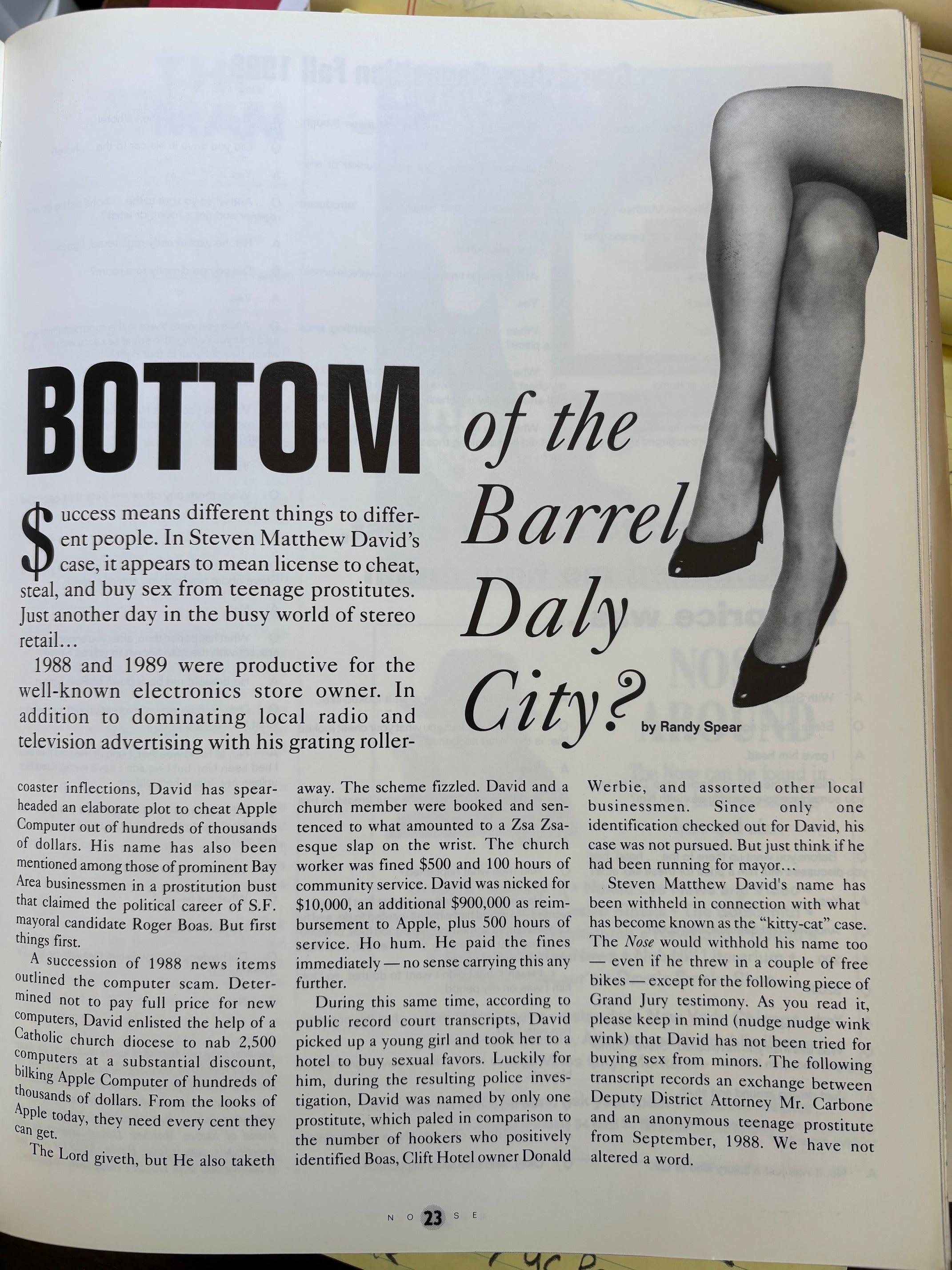
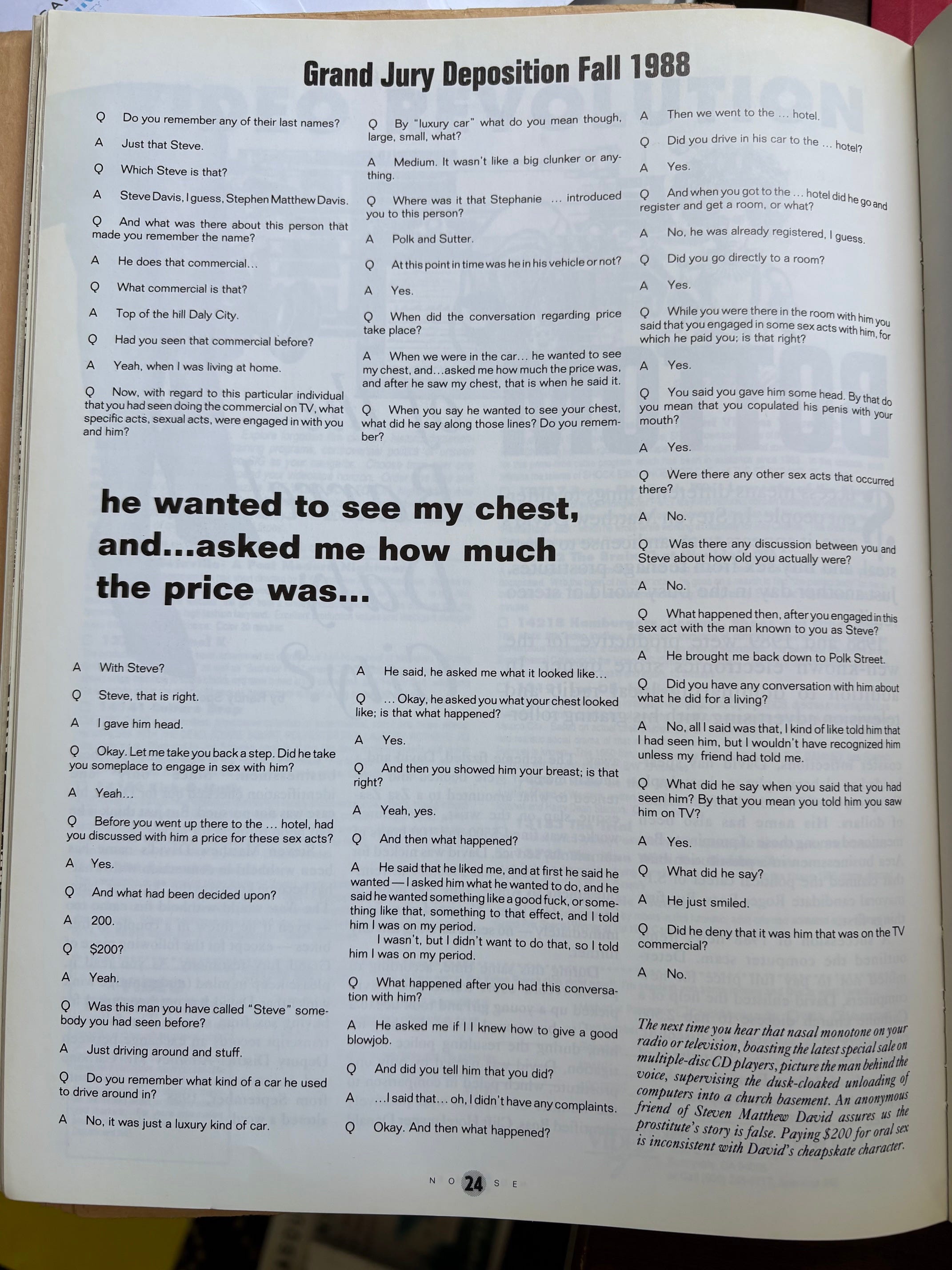
From The Nose magazine, 1990.
Our article appeared in 1990, and soon after publication we were told by an employee of the stereo shop that David himself had issued a company-wide memo about our story. He denied all knowledge of the kitty-cat case, of course, and referred to The Nose as “a magazine of unknown and unsavory origin.” We immediately began using the phrase in our subscription offers.
The Matthew’s store went out of business in 1992, and the building is now location of a dollar store. After a long illness, Steven Matthew David, high school valedictorian and magna cum laude graduate of Harvard, passed away in January 2026.
Unknown and unsavory. Chef's kiss.
Everyone of our generation in the South Bay remembers Ed Barbara of Furniture USA. Those "HI KIDS!" commercials were everywhere, in-between Cal Worthington masterpieces, of course ...